

For the past three decades, the gospel of supply chain management has been simple: efficiency. We have built vast, complex, and interconnected global networks with a single-minded focus on driving down costs. This has also created a hidden vulnerability of catastrophic proportions.
The Strategic Compass: From Cost Optimization to Risk Mitigation
The core challenge is that we have optimized for a world that no longer exists. We have built a system that assumes a stable, predictable, and frictionless global trade environment. But in the face of a global pandemic, escalating geopolitical tensions, and the increasing frequency of extreme weather events, that assumption has been shattered.
The pursuit of efficiency at all costs has left us exposed.
This article is a founder's guide to moving beyond the outdated paradigm of cost optimization and embracing a new imperative: resilience. It is a strategic framework for building a supply chain that can not only withstand the shocks of an uncertain world but can also become a powerful source of competitive advantage.
The Myth of the "Black Swan": Why We Should Have Seen This Coming
It is tempting to view the recent wave of supply chain disruptions as a series of unpredictable "black swan" events. This is a comforting but dangerous narrative. The reality is that the fragility of our global supply chains was a known and predictable risk. We simply chose to ignore it in the pursuit of short-term profits.
The pandemic did not break the global supply chain; it merely exposed the cracks that were already there.
To build a resilient supply chain, we must first abandon the illusion of predictability and embrace the reality of uncertainty. We must move from a "just-in-time" to a "just-in-case" mindset.
The Resilient Supply Chain Framework: 4 Pillars of a Modern Supply Chain
Building a resilient supply chain is not about abandoning efficiency; it is about balancing efficiency with robustness. It is about building a system that is not only lean but also flexible, agile, and intelligent. This framework is built on four key pillars.
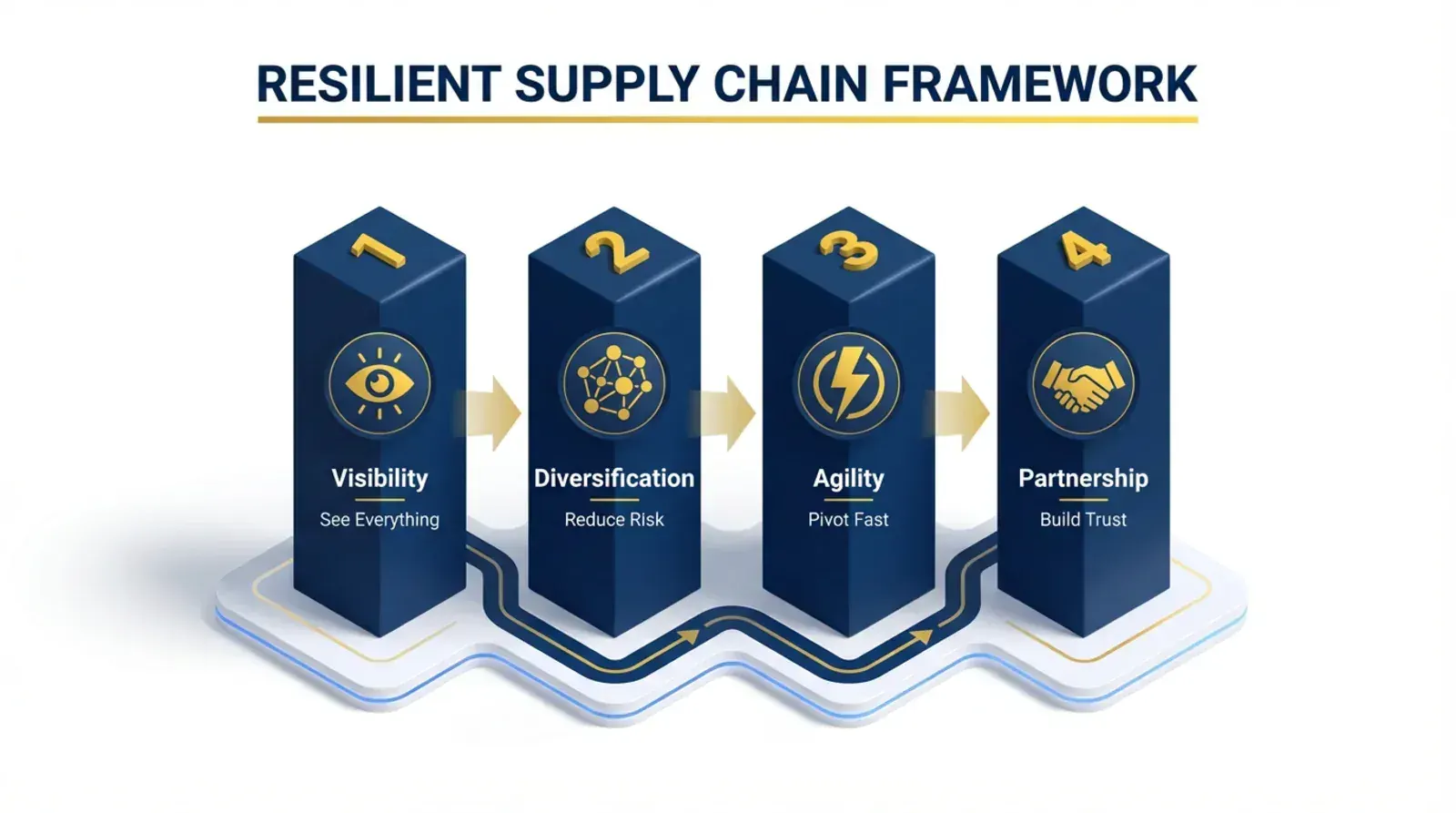
| Pillar | Strategic Principle | The Goal |
|---|---|---|
| 1. Visibility | You can't manage what you can't see. | To create a single source of truth for your entire supply chain. |
| 2. Diversification | Don't put all your eggs in one basket. | To reduce your dependence on any single supplier, region, or logistics route. |
| 3. Agility | The ability to pivot quickly in the face of disruption. | To build a supply chain that can bend without breaking. |
| 4. Partnership | Your suppliers are not your adversaries. | To build deep, collaborative relationships based on trust and transparency. |
1. Visibility: From a Black Box to a Glass Box
For many businesses, their supply chain is a black box. They place an order with a supplier and have little to no visibility into the production process, the sub-suppliers, or the logistics journey. This lack of visibility is a massive liability.
To build a resilient supply chain, you must invest in the technology and the processes required to create end-to-end visibility. You need a single source of truth that allows you to track your inventory, your orders, and your shipments in real-time.
2. Diversification: The End of the Single-Source Era
The era of relying on a single supplier in a single country is over. The geopolitical and environmental risks are simply too great. A resilient supply chain is a diversified supply chain.
This means diversifying your supplier base across multiple regions, diversifying your logistics routes, and even diversifying your product designs to allow for more flexibility in your material sourcing. Diversification is not just a risk mitigation strategy; it is a powerful enabler of growth and innovation.
3. Agility: The Ability to Respond to the Unexpected
In a world of constant disruption, the ability to pivot quickly is a critical survival skill. A resilient supply chain is an agile supply chain. This means shorter planning cycles, more frequent forecasting, and the ability to make decisions quickly based on real-time data.
It also means building a culture of empowerment where your team has the authority to make decisions on the front lines.
4. Partnership: From Transactional to Relational
In a traditional supply chain, the relationship between a buyer and a supplier is often adversarial. It is a zero-sum game of price negotiation and cost-cutting. In a resilient supply chain, the relationship is a partnership.
It is a long-term, collaborative relationship built on a foundation of trust, transparency, and shared goals. Your suppliers are not just vendors; they are an extension of your team. Invest in those relationships, and they will pay you back tenfold in times of crisis.
The Strategic Perspective: The ROI of Resilience
Building a resilient supply chain requires a significant investment of time, money, and leadership attention. It is not a quick fix or a cheap solution. But the return on that investment is immense.
A resilient supply chain is not just a defensive measure; it is a powerful offensive weapon. It allows you to take market share from your less prepared competitors in times of crisis. It allows you to offer your customers a level of reliability and predictability that becomes a powerful differentiator.
And it allows you to sleep at night, knowing that your business is built to withstand the storms of an uncertain world.
The Infinite Game: Your Supply Chain as a Source of Enduring Advantage
The future of business will be defined by a new level of volatility and uncertainty. The companies that thrive in this new era will be the ones that have embraced the principles of resilience.
They will be the companies that have moved beyond the narrow pursuit of efficiency and have built supply chains that are as robust and as adaptable as they are lean.
Building a resilient supply chain is not just a project; it is a fundamental shift in mindset. It is a commitment to playing the infinite game of business, where the goal is not just to win, but to keep playing.
Ready to build supply chain resilience?
Book Your Strategic Session