

The Strategic Compass: From Transactional Sourcing to Strategic Partnerships
For many founders, sourcing from China feels like a high-stakes gamble. You know the potential rewards—lower manufacturing costs, access to incredible production capacity—but the risks are just as palpable. The dream of launching a product can quickly devolve into a nightmare of communication breakdowns, quality control disasters, and outright scams. You are forced to navigate an opaque system from thousands of miles away, where a single misstep can jeopardize your entire business.
This isn't a problem you can solve with wishful thinking or by simply crossing your fingers. The core issue is a lack of a systematic approach. This article moves beyond tactical tips and provides a strategic framework for founders to navigate the complexities of the Greater Bay Area. It's about replacing guesswork with a battle-tested process to build a resilient supply chain with confidence and precision.
Why Does Sourcing from China Feel So Risky?
The fundamental challenge is a lack of transparency. When you're on the other side of the world, it's difficult to answer the questions that matter most: Is this supplier legitimate? Can they meet my quality standards? Will they deliver on time? This information asymmetry creates a power imbalance that leaves many founders feeling vulnerable and exposed.
Without a rigorous vetting process, you are essentially playing a game of chance. The solution is to shift your mindset from transactional sourcing to building strategic partnerships. This requires a systematic, 7-step vetting process.
The 7-Step Framework for Building a Resilient Supply Chain
This isn't a theoretical checklist; it's a battle-tested process for turning potential suppliers into reliable, long-term partners.
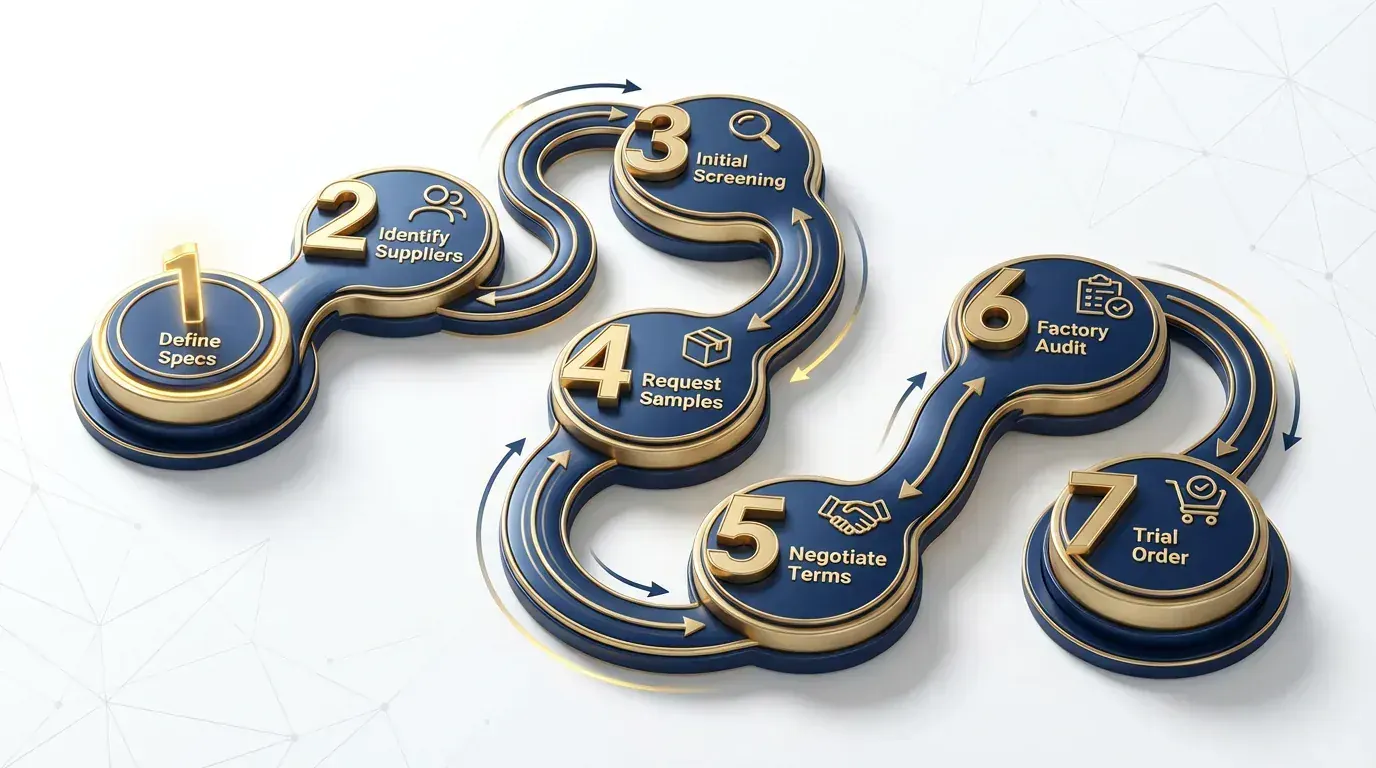
| Step | Strategic Action | Why It Matters (The "Belief") |
|---|---|---|
| 1. Define Specs | Create a detailed Product Specification Sheet. | Clarity is your best defense against miscommunication and quality issues. |
| 2. Identify Suppliers | Use a multi-pronged approach (Alibaba, trade shows, referrals). | Casting a wide net increases your chances of finding a hidden gem. |
| 3. Initial Screening | Verify business licenses, company profiles, and contact info. | This weeds out the obvious scams and unqualified players early on. |
| 4. Request Samples | Pay for and evaluate samples against your spec sheet. | A small investment now prevents a massive loss later. This is non-negotiable. |
| 5. Negotiate Terms | Discuss price, payment terms, lead times, and shipping. | A mutually beneficial agreement sets the foundation for a healthy partnership. |
| 6. Factory Audit | Conduct an on-site audit for large or complex orders. | This is the ultimate verification step. It confirms capacity and professionalism. |
| 7. Trial Order | Place a small, low-risk order to test the entire process. | This is a final dress rehearsal before you commit to a large-scale production run. |
1. What Are You Actually Building?
Before you can find the right partner, you must have absolute clarity on what you are asking them to build. A detailed Product Specification Sheet is not just a document; it is the blueprint for your product. It should include materials, dimensions, colors, tolerances, packaging, and labeling requirements. The more detail you provide, the less room there is for error.
Strategic Application: Your spec sheet should be so detailed that a supplier can give you an accurate quote without having to ask a single question. This demonstrates your professionalism and forces a higher level of accountability.
2. How Do You Find Potential Partners (Not Just Suppliers)?
While online directories like Alibaba and Global Sources are a good starting point, relying on them exclusively is a mistake. The best partners are often found through referrals from other founders or at industry trade shows. Your goal is not to find the most suppliers, but to find the right ones.
3. How Do You Separate the Signal from the Noise?
Your initial screening is a crucial filtering process. A legitimate business will have a verifiable business license, a professional website, and a clear physical address. If a supplier is hesitant to provide this information, that is a major red flag. This step is tedious but essential for mitigating risk.
4. Are You Willing to Invest in Quality?
Requesting and paying for samples is a non-negotiable step. This is your first real opportunity to assess a supplier's quality, attention to detail, and ability to follow instructions. If the sample isn't right, the bulk order won't be either.
5. How Do You Structure a Win-Win Agreement?
Negotiation is not about winning; it's about building a sustainable partnership. While price is important, it should not be the only factor. Favorable payment terms (e.g., 30% upfront, 70% upon completion) and clear lead times are just as critical. A supplier who is unwilling to negotiate reasonable terms may not be a good long-term partner.
6. Should You Go and See for Yourself?
For any significant order, a factory audit is a wise investment. An audit allows you to verify a supplier's claims, assess their working conditions, and build a personal relationship with the management team. If you cannot go yourself, there are reputable third-party services that can conduct an audit on your behalf.
7. Can You Trust Them with a Small Bet?
A trial order is your final risk-mitigation step. It allows you to test the supplier's entire process, from production to communication to logistics, on a small, manageable scale. A successful trial order provides the confidence you need to move forward with a larger commitment.
The Strategic Perspective: Common Sourcing Traps
- The Price Trap: The cheapest quote is often the most expensive in the long run. It can be a sign of low-quality materials, poor working conditions, or a desperate supplier who will cut corners.
- The Complacency Trap: Don't assume a successful first order guarantees a successful second. Quality can fade over time. Implement ongoing quality control measures.
- The Single-Source Trap: Relying on a single supplier is a recipe for disaster. Always have a backup supplier, even if you are not actively using them.
The Infinite Game: Your Supply Chain as a Competitive Advantage
In the past, sourcing was a cost center. In the future, a resilient, transparent, and ethical supply chain will be a powerful competitive advantage. The founders who will win are not those who find the cheapest supplier, but those who build the strongest, most collaborative partnerships.
Your supply chain is not just a series of transactions; it is a network of relationships. Nurture those relationships, invest in them, and they will pay dividends for years to come.