

The Strategic Compass: Are Your Departments at War with Each Other?
In the relentless pursuit of growth, most companies inadvertently create a state of internal conflict. Your marketing team is at war with your sales team over lead quality. Your sales team is at war with your product team over missing features. Your product team is at war with your operations team over execution timelines. Each department is optimizing for its own metrics, hitting its own targets, and, in the process, undermining the overall growth of the business.
This isn't a people problem; it's a system problem. The core challenge is a lack of a single, unifying strategy that aligns every function of the business toward a common goal. The result is a fragmented, inefficient, and often chaotic approach to growth that leaves immense value on the table. At SPARK4BRAND, we believe that exponential growth is not achieved through siloed excellence but through strategic integration.
This article outlines our Integrated Growth Strategy Framework, a practical roadmap for dismantling the silos and building a cohesive growth machine. It's about transforming your company from a collection of competing fiefdoms into a single, high-performance engine for sustainable growth.
The Crisis of Siloed Growth: Why Your Business Feels Stuck
The symptoms of a siloed growth strategy are easy to spot: friction between departments, inconsistent customer experiences, and a feeling that the business is working incredibly hard just to stand still. Marketing generates leads that sales can't close. Sales makes promises that the product can't deliver. The product team builds features that nobody uses. Each department may be hitting its individual KPIs, but the business as a whole is failing to reach its potential.
The solution is to architect a system where every part of the business is not only aware of the other parts but is actively working to support them. This requires a holistic framework that connects market positioning, product-market fit, go-to-market strategy, brand messaging, and operational execution into a single, coherent system.
The Integrated Growth Strategy Framework
Our framework consists of five interconnected components that build upon each other to create a powerful, self-reinforcing growth loop.
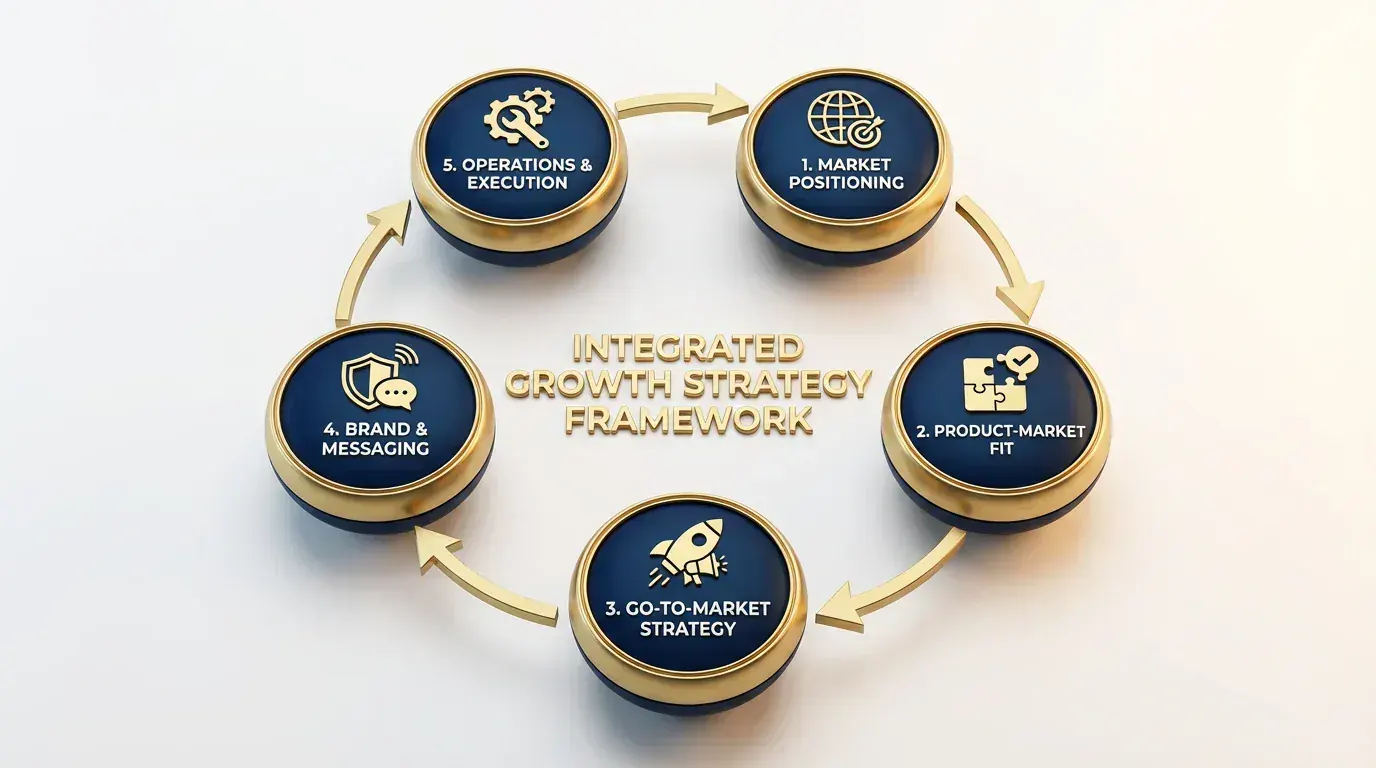
| Component | Strategic Question | Desired Outcome |
|---|---|---|
| 1. Market Positioning | Who do you serve, what problem do you solve, and why are you different? | A clear, defensible position in the market that guides all other decisions. |
| 2. Product-Market Fit | Are you building something your target market desperately wants and is willing to pay for? | A product that pulls customers in, rather than needing to be pushed on them. |
| 3. Go-to-Market Strategy | How do you efficiently acquire, activate, and retain your ideal customers? | A scalable and repeatable process for turning strangers into advocates. |
| 4. Brand & Messaging | How do you communicate your value to the market in a way that resonates? | A consistent and compelling narrative that builds trust and drives action. |
| 5. Operations & Execution | Is your team structured and equipped to execute the strategy effectively? | An organizational engine that can translate strategy into real-world results. |
1. What is Your Unshakable Market Position?
Your market positioning is the bedrock of your entire growth strategy. It is a clear, concise, and defensible statement that answers three critical questions: Who is your ideal customer? What is the specific problem you solve for them? And why are you uniquely positioned to solve it? A strong market position acts as a filter, allowing you to say "no" to distractions and focus your resources on the opportunities that matter most.
Strategic Application: A B2B software company might move from a generic position like "CRM for small businesses" to a specific position like "The all-in-one clientflow platform for independent consultants who want to scale without hiring."
2. How Do You Achieve and Maintain Product-Market Fit?
Product-market fit is the magical state where your product and your target market are in perfect harmony. It's the point where customers are not just buying your product but are actively pulling it from you. Achieving product-market fit is not a one-time event; it is an ongoing process of listening to your customers, iterating on your product, and relentlessly improving the alignment between what you offer and what the market needs.
3. What is Your Go-to-Market Machine?
Your go-to-market strategy is the engine that drives customer acquisition, activation, and retention. It encompasses your pricing, your sales process, your marketing channels, and your customer success strategy. A well-designed go-to-market strategy is not a random collection of tactics; it is a carefully orchestrated system designed to efficiently and predictably convert your ideal customers.
4. Does Your Brand Tell a Story People Care About?
Your brand and messaging are the narrative layer of your growth strategy. They are how you communicate your positioning and value proposition to the world. Your brand must be consistent across every touchpoint, and your messaging must be clear, compelling, and focused on the outcomes your customers care about. A great brand doesn't just explain what you do; it makes people feel understood.
5. Can Your Operations Actually Deliver on the Strategy?
A brilliant strategy is worthless without the operational capacity to execute it. Your organizational structure, your internal processes, your technology stack, and the skills of your team must all be aligned to support your growth objectives. Operations are not a back-office function; they are the gears that turn the flywheel of your growth machine.
The Strategic Perspective: The Myth of the "Growth Hack"
The allure of the "growth hack" is powerful but dangerous. It promises a silver bullet, a shortcut to success that bypasses the hard work of building a sustainable business. The reality is that lasting growth is not the result of a single trick or tactic. It is the result of a deeply integrated system where every component is working in concert. The most powerful growth hack is to stop looking for shortcuts and start building a cohesive, integrated growth strategy.
The Infinite Game: From Growth Strategy to Strategic Growth
The companies that will dominate the future are not those with the best product, the best marketing, or the best sales team. They are the companies with the most integrated and aligned growth strategy. They are the companies that have broken down the silos and built a single, unified team that is relentlessly focused on creating value for their customers.
Building an integrated growth strategy is not easy. It requires discipline, courage, and a willingness to challenge the status quo. But for the founders who are willing to do the work, the reward is not just growth, but sustainable, scalable, and ultimately, more meaningful success.