

The Strategic Compass: From Hype to Value
Walk into any boardroom today and you'll hear it: "We need an AI strategy." But what does that actually mean? For most companies, it's a vague gesture toward transformation, accompanied by a budget allocation and a hope that the technology will somehow figure itself out. The result? 85% of AI projects fail to deliver measurable ROI, and many become expensive science experiments that never leave the lab.
The problem isn't the technology—it's the approach. Companies rush to implement AI without first understanding why they need it, what problem it should solve, and how they'll measure success. This article isn't about the latest AI models or algorithms. It's a reality check for leaders: a framework for understanding why AI projects fail and how to build AI capabilities that deliver real, sustainable business value.
Why Most AI Projects Fail: The 5 Failure Modes
AI failure isn't random. It follows predictable patterns. Here are the five failure modes that sabotage most AI implementations:
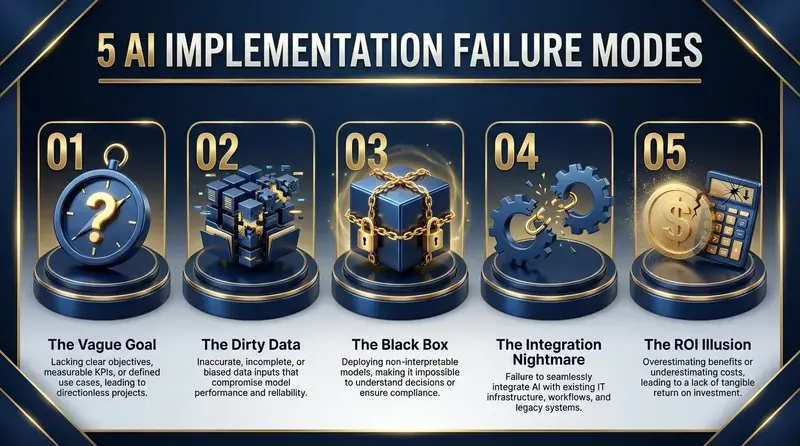
| Failure Mode | Symptom | Root Cause |
|---|---|---|
| 1. The Vague Goal | "We need an AI strategy." | No specific, measurable business problem defined |
| 2. The Dirty Data | "The model isn't accurate." | Underestimating data quality and preparation time |
| 3. The Black Box | "We don't know why it decided that." | Lack of transparency and explainability |
| 4. The Integration Nightmare | "It doesn't work with our systems." | Failure to account for deployment realities |
| 5. The ROI Illusion | "We know it's valuable, we just can't prove it." | No clear, pre-defined success metrics |
1. The Vague Goal: "We Need an AI Strategy"
The Problem: Most AI projects start with enthusiasm but no clear destination. "Let's use AI to improve customer experience" sounds good in a meeting, but it's not actionable. What specific outcome are you trying to achieve? Which customer experience metric matters most? What does success look like in dollars and cents?
The Fix: Define a specific, measurable business problem. Not "improve customer retention" but "reduce customer churn by 15% in the next six months by building a predictive model that identifies at-risk customers with 90% accuracy."
2. The Dirty Data: "Garbage In, Garbage Out"
The Problem: AI models are only as good as the data they're trained on. Most companies underestimate the time and effort required to clean, label, and structure their data. If your data is incomplete, biased, or inconsistent, your AI will be too.
The Fix: Before building any model, audit your data. Do you have enough? Is it representative? Is it labeled correctly? Budget at least 50% of your AI project timeline for data preparation. It's not glamorous, but it's the foundation of success.
3. The Black Box: "Why Did It Decide That?"
The Problem: Many AI models are opaque. They make predictions, but they don't explain their reasoning. When a model denies a loan application or flags a transaction as fraudulent, can you explain why? If not, you have a transparency problem—and potentially a legal and ethical one.
The Fix: Prioritize explainability from day one. Use interpretable models when possible. For complex models, implement tools like SHAP or LIME to generate explanations. Your stakeholders—and regulators—will thank you.
4. The Integration Nightmare: "It Doesn't Work with Our Systems"
The Problem: Building a working prototype in a sandbox is one thing. Deploying it into production with real-time data, legacy systems, and regulatory constraints is another. Many AI projects stall because they were built in isolation without considering the operational realities of integration.
The Fix: Involve IT, operations, and compliance teams early. Map out the deployment environment before you build. Test with real data in real systems. A model that works in a Jupyter notebook but fails in production is worthless.
5. The ROI Illusion: "We Know It's Valuable"
The Problem: AI projects often start with a vague promise of "value" but no concrete way to measure it. When leadership asks, "What's the ROI?" the answer is usually hand-waving: "It improves efficiency" or "It enhances customer satisfaction." Without clear metrics, you can't prove success—and you can't secure funding for the next project.
The Fix: Define success metrics before you build. Tie them to dollars: revenue increase, cost reduction, time saved. Track them rigorously. If you can't measure it, you can't manage it.
The Strategic Approach: Building AI That Works
Avoiding these failure modes requires a shift in mindset—from technology-first to value-first. Here's the strategic approach that works:
1. Start with the Business Problem, Not the Technology
Ask: "What specific business outcome do we want to achieve?" Only then ask, "Can AI help us get there?" AI is a tool, not a strategy.
2. Build a Data Foundation First
Invest in data infrastructure: pipelines, governance, quality assurance. Without clean, reliable data, AI is impossible.
3. Start Small, Scale Fast
Don't bet the farm on a massive AI transformation. Start with a small, high-impact pilot. Prove value. Learn. Iterate. Then scale.
4. Build for Production, Not Just Prototypes
Design with deployment in mind from day one. Work closely with IT and operations. Test in real environments.
5. Measure Ruthlessly
Define clear, quantifiable success metrics. Track them continuously. Be prepared to kill projects that don't deliver.
The Infinite Game: AI as a Capability, Not a Project
The most successful companies don't treat AI as a one-time project. They build it as an ongoing capability—a muscle they flex and strengthen over time. They invest in data infrastructure, upskill their teams, and embed AI into their culture. They know that AI isn't a destination; it's a journey of continuous learning and improvement.
If you're serious about AI, stop chasing the hype. Start with clarity: a specific problem, clean data, clear metrics, and a realistic deployment plan. Build small, learn fast, and scale deliberately. That's how you move from AI projects that fail to AI capabilities that transform your business.
Ready to implement AI that actually works?
Book Your Strategic Session