

The Strategic Compass: Why Music Matters for Your Brand
What if your brand's message could be sung, not just said? In an era where consumers scroll past thousands of text posts daily, music cuts through the noise. It bypasses rational filters and speaks directly to emotion. A well-crafted song can make your brand memorable, shareable, and emotionally resonant in ways that traditional content never could.
The challenge for most brands isn't recognizing the power of music—it's the cost, time, and expertise required to create it. Hiring composers, lyricists, vocalists, and producers can take months and cost tens of thousands of dollars. For small businesses and startups, it's been out of reach. Until now.
AI music generation has democratized sonic branding. What once required a full production studio can now be created in hours. But here's the catch: the technology is worthless without strategy. This article is a guide for leaders who want to harness AI music not as a gimmick, but as a strategic tool for building emotional connections, telling stories, and amplifying their brand voice.
Why Music Works Where Words Fail
Music isn't just a nice-to-have. It's a fundamentally different communication medium with unique advantages:
- Emotional Resonance: Music bypasses the rational brain. It creates feelings that paragraphs of copy cannot. A song can make you feel proud, inspired, nostalgic, or energized—instantly.
- Memory Retention: We remember melodies far better than text. Your brand message, set to music, becomes unforgettable. Think of jingles that have stayed in your head for decades.
- Cross-Cultural Communication: While words require translation, melodies transcend language barriers. This is critical for global brands operating across China, Europe, and America.
- Shareability: People share songs. They don't share press releases. A compelling brand song can go viral organically, amplifying your reach at zero marginal cost.
The AI Music Revolution: From Concept to Creation in Minutes
Modern AI music platforms have reached a tipping point. They can now generate complete songs—vocals, lyrics, instrumentation—in any genre, in minutes. Here's what's possible today:
- Generate full songs with human-quality vocals and professional production
- Create custom soundtracks that match your brand's emotional tone
- Produce multilingual versions maintaining the same melody and feel
- Iterate instantly—try 10 different versions in the time it takes to brief a composer
- Adapt concepts to different markets and demographics without starting from scratch
The result? Brands can now afford to have a sonic identity. Not just a logo and a tagline, but a sound—a musical signature that makes every piece of content more engaging, more memorable, and more emotionally powerful.
The 4-Step Framework for Strategic AI Music Implementation
Creating AI music is easy. Creating AI music that drives business results requires a disciplined, strategic approach. Here's the framework we use with our clients:
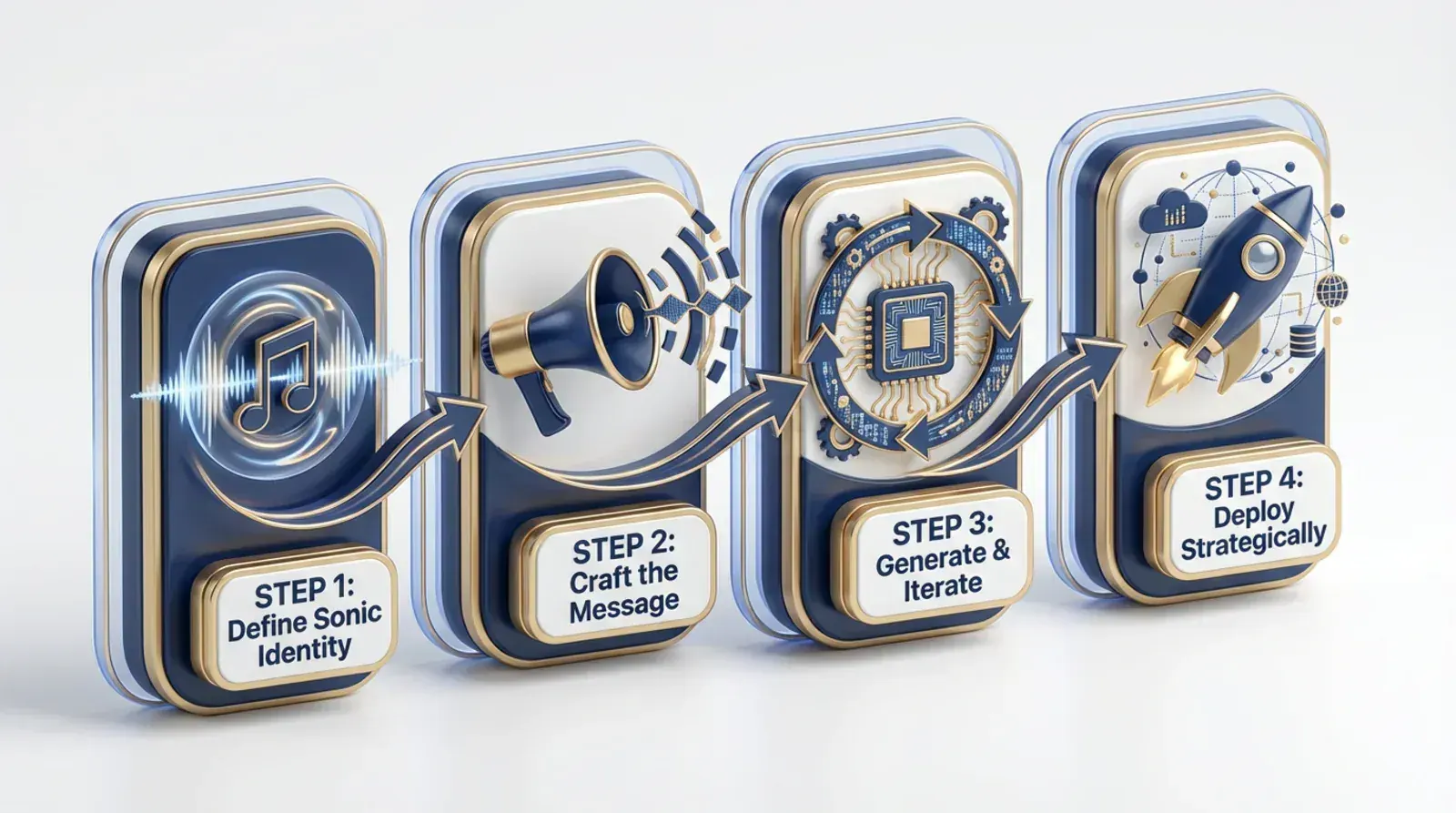
| Step | Strategic Action | Key Question |
|---|---|---|
| 1. Define Sonic Identity | Establish your brand's emotional tone and musical personality | What emotion do you want listeners to feel? |
| 2. Craft the Message | Develop a narrative arc with a clear hook and call to action | What's the one message worth amplifying? |
| 3. Generate & Iterate | Use AI to create multiple variations and test with real audiences | Which version resonates most deeply? |
| 4. Deploy Strategically | Integrate music across all touchpoints as a brand asset | Where will this music live and work 24/7? |
Step 1: Define Your Sonic Brand Identity
Before generating a single note, you must answer these questions:
- Emotional Goal: What emotion do you want listeners to feel? Trust? Excitement? Calm confidence? Innovation?
- Brand Personality: Is your brand energetic or calm? Bold or trustworthy? Professional or playful?
- Audience Resonance: What music does your target audience already listen to and respond to?
- Core Message: What's the one truth you want to communicate through sound?
Example: A B2B SaaS company targeting enterprise CTOs might choose a sonic identity that's "confident, modern, and trustworthy"—perhaps a blend of electronic and orchestral elements that suggests both innovation and reliability.
Step 2: Craft the Message Architecture
Music amplifies your message—but you need a message worth amplifying. Work backward from your strategic goal:
- The Hook: The memorable phrase that captures your core value proposition. This becomes your lyrical anchor.
- The Story Arc: The emotional journey from problem to solution. This shapes the musical progression from verse to chorus.
- The Call to Action: What do you want listeners to feel and do after hearing your song?
Example: A supply chain platform might tell the story: Verse (chaos of unreliable suppliers) → Chorus (confidence with our platform) → Bridge (scale without stress) → Final Chorus (your business, amplified).
Step 3: AI Generation & Iteration
With strategy in place, AI becomes your creative accelerator. Here's the process:
- Generate 10+ variations in different styles (pop, rock, electronic, hip-hop) and moods
- Test with real audiences quickly and cost-effectively using social media polls or internal teams
- Refine based on data, not gut feeling. Which version gets the most shares? Which generates the strongest emotional response?
- Create market-specific versions for Chinese, European, and American audiences while maintaining brand consistency
The beauty of AI: you can try 20 different approaches for the cost of one traditional demo. Fail fast, learn quickly, and find the version that truly resonates.
Step 4: Strategic Deployment
A brand song isn't a campaign—it's an asset. Treat it as infrastructure, not content. Deploy it across:
- Social Media: TikTok, Instagram Reels, YouTube Shorts—platforms where music drives engagement
- Product Content: Demos, tutorials, onboarding videos become more engaging with a sonic identity
- Events & Trade Shows: Imagine your booth with its own anthem that visitors remember long after they leave
- Internal Communications: Unite distributed teams with a shared sonic culture
- Customer Touchpoints: On-hold music, email signatures with audio, branded podcasts
Real-World Applications: Beyond Background Music
Product Launch Anthems
Instead of a press release, launch your product with a custom song that captures its essence. One that your customers will want to share, remix, and make their own. Turn your launch into a cultural moment.
Company Values & Culture
What if your mission statement was a song your team could sing together? AI-generated music can turn abstract values into shared emotional experiences that unite teams across continents. Culture isn't a document; it's a feeling.
Customer Stories as Songs
Transform testimonials into narrative songs. Let your customers' voices—their challenges, their breakthroughs, their gratitude—become part of your brand's soundtrack. It's authentic, engaging, and incredibly shareable.
Educational Content
Complex technical concepts become accessible when set to music. Training materials, product tutorials, and compliance documentation can be transformed into memorable learning experiences. People remember songs; they forget PDFs.
The Reality Check: What AI Music Can (and Can't) Do
Let's be honest. AI music generation is powerful, but it's not magic. Here's what you need to know:
What Works Brilliantly:
- Genre-specific compositions (pop, rock, electronic, classical, hip-hop)
- Background music and soundscapes for videos and presentations
- Quick iteration and variation testing
- Multilingual vocal generation with consistent melody
- Cost-effective production at scale
What Still Needs Human Judgment:
- Strategic Message Architecture: AI can't decide what your brand should say—only you can
- Lyrical Nuance: Cultural sensitivity, double meanings, and emotional authenticity require human oversight
- Final Polish: Professional releases may need mixing and mastering by experienced audio engineers
- Rights & Licensing: Navigating copyright and usage rights requires legal expertise
- Deployment Strategy: Where and how to use music for maximum impact is a human decision
The Infinite Game: Your Brand's Sonic Legacy
The most successful brands don't just look distinctive—they sound distinctive. Intel's five-note signature. Netflix's "ta-dum." McDonald's "I'm Lovin' It." These aren't accidents. They're strategic sonic assets that have been cultivated over decades.
AI music generation gives every brand—no matter how small—the ability to build a sonic identity. The question isn't whether you can afford to do it. The question is: can you afford not to? In a world where attention is scarce and emotions drive decisions, music is one of the most powerful tools you have.
Start small. Create one song that captures your brand's essence. Test it. Refine it. Deploy it. Watch how it changes the way people engage with your content, remember your message, and feel about your brand. That's the power of music. That's the opportunity of AI.