

The Strategic Compass: From "How Do I Get Funded?" to "Should I Get Funded?"
In the mythology of the startup world, venture capital is the holy grail. It is the ultimate validation of a founder's vision, the jet fuel that will propel their company to unimaginable heights. The narrative is so powerful and so pervasive that most founders never stop to ask the most fundamental question: Should I even be raising venture capital in the first place?
The core challenge is that we have conflated building a business with building a venture-backable business. They are not the same thing. In fact, they are often two fundamentally different paths, with different goals, different timelines, and different definitions of success. The decision to raise venture capital is not just a financial one; it is a decision that will fundamentally alter the DNA of your company, your role as a founder, and the very nature of the game you are playing.
This article is a founder's guide to navigating one of the most important decisions you will ever make. It is a strategic framework for moving beyond the seductive allure of venture capital and making a clear-eyed, intentional choice between bootstrapping and fundraising. It's about understanding that the right path for you is the one that aligns with your personal values, your business model, and your long-term vision for the life you want to lead.
The Two Paths: A Tale of a Tortoise and a Hare
Imagine two founders, both with a brilliant idea and a burning ambition to build a great company.
- The Bootstrapper (The Tortoise): This founder chooses to build their business with their own resources and the revenue they generate from their customers. Their growth is slow, deliberate, and profitable from day one. They retain 100% ownership of their company and have complete control over their own destiny. Their goal is to build a sustainable, profitable business that can endure for decades.
- The Venture-Backed Founder (The Hare): This founder chooses to raise money from venture capitalists. They trade a significant portion of their ownership and control for a large infusion of cash. Their goal is no longer just to build a great business; it is to build a business that can generate a 10x return for their investors in a 5-10 year timeframe. They are on a path of hyper-growth, a high-stakes race to dominate a massive market.
Neither of these paths is inherently right or wrong. But they are fundamentally different. The tragedy is that many founders stumble onto the venture-backed path without fully understanding the implications of their choice.
The Decision Framework: 4 Questions to Ask Before You Raise a Single Dollar
This framework is designed to help you make a conscious and strategic choice between these two paths.
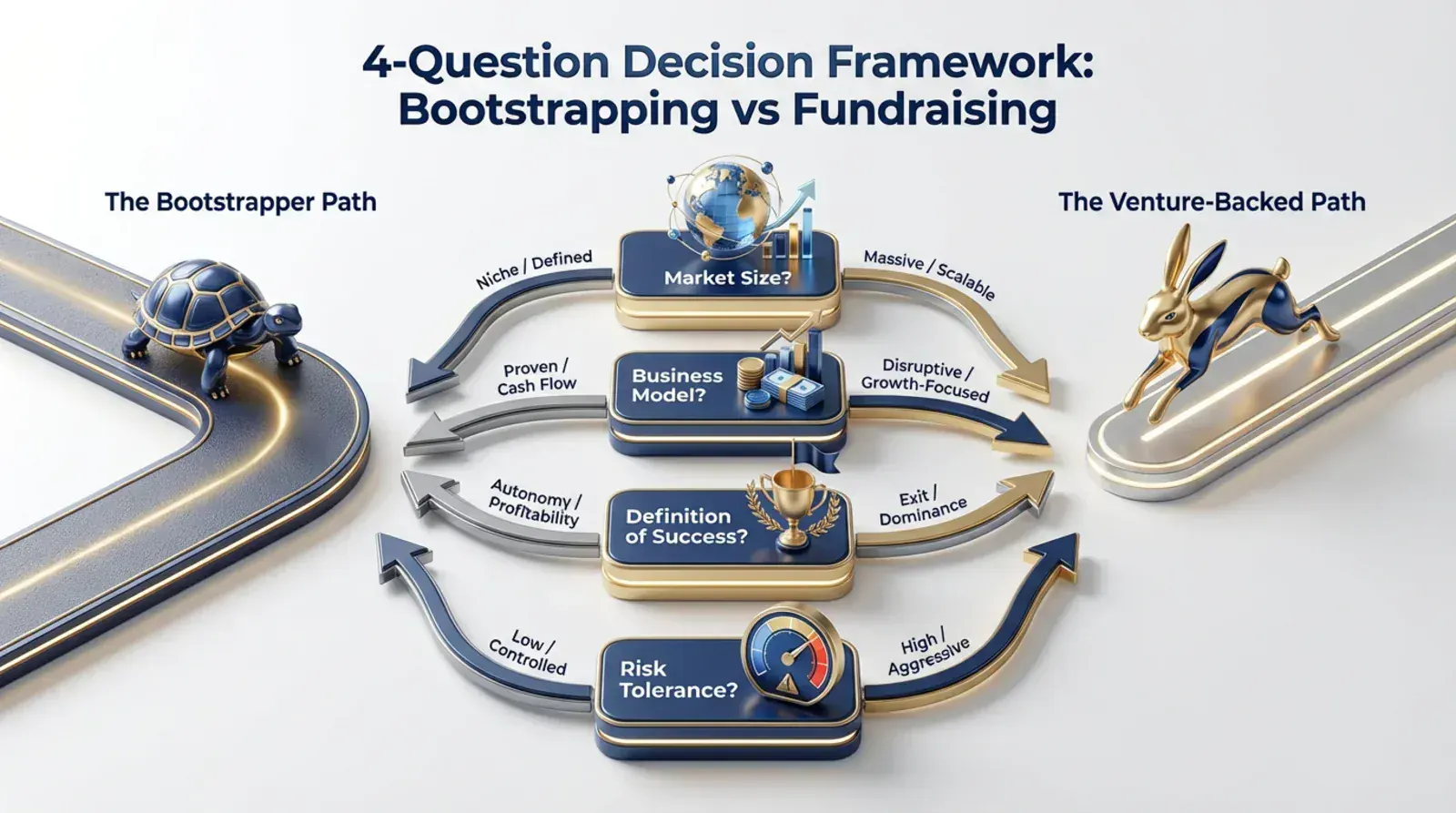
| Question | The Bootstrapper's Answer | The Venture-Backed Founder's Answer |
|---|---|---|
| 1. What is the size of your market? | A niche market that can support a profitable, multi-million dollar business | A massive, multi-billion dollar market that can support a 10x return |
| 2. What is your business model? | High-margin, profitable from day one, and capital-efficient | A model that requires significant upfront investment in technology, inventory, or customer acquisition |
| 3. What is your personal definition of success? | Freedom, autonomy, and the ability to build a business on my own terms | Building a massive company, changing the world, and a large financial exit |
| 4. What is your tolerance for risk? | I prefer to grow slowly and control my own destiny | I am willing to risk it all for a chance at a massive outcome |
1. The Market Size Litmus Test: Are You in a Pond or an Ocean?
Venture capital is a game of outliers. VCs are not looking for good businesses; they are looking for businesses that have the potential to become billion-dollar companies. This means that you must be operating in a massive, multi-billion dollar market. If you are building a great business in a smaller, niche market, venture capital is not for you. And that is perfectly okay. A profitable, multi-million dollar business that you own 100% of is a phenomenal outcome.
Strategic Application: If your total addressable market is less than $1 billion, venture capital may not be a realistic option—and that's not a failure. It's a signal to pursue a bootstrapped path to profitability and ownership.
2. The Business Model Litmus Test: Is Your Business a Cash-Eating Monster?
Some business models are inherently capital-intensive. They require a significant upfront investment in research and development, inventory, or customer acquisition before they can generate a single dollar of revenue. If you are building a business like this, you may have no choice but to raise outside capital. But if you have a business model that is high-margin, capital-efficient, and can be profitable from day one, you have the luxury of choice.
Strategic Application: If your business can reach profitability with less than $500K in investment, bootstrapping becomes a viable and attractive option that preserves your ownership and control.
3. The Personal Definition of Success Litmus Test: What Game Are You Playing?
This is the most important and most overlooked question. What do you, as a founder, really want? Do you want the freedom and autonomy that comes with 100% ownership? Or do you want the thrill and the challenge of building a massive, world-changing company, even if it means giving up a significant amount of control? There is no right answer, but you must be honest with yourself about what game you are really playing.
Strategic Application: If your definition of success includes terms like "lifestyle," "autonomy," "freedom," or "sustainable pace," venture capital may be fundamentally incompatible with your goals.
4. The Risk Tolerance Litmus Test: Are You a Tortoise or a Hare?
Bootstrapping is a marathon. It is a slow, steady, and relatively low-risk path to building a valuable company. Raising venture capital is a sprint. It is a high-risk, high-reward race to the top. You must have an honest assessment of your own personality and your tolerance for risk. Are you a tortoise or a hare?
Strategic Application: If the thought of "bet-the-company" decisions and binary outcomes (unicorn or bust) keeps you up at night, the bootstrapped path offers a more sustainable alternative.
The Strategic Perspective: The Third Way - The "Bootstrapped Plus" Model
The choice between bootstrapping and fundraising is not always a binary one. There is a third way, a hybrid model that is becoming increasingly popular. In this model, a founder bootstraps their business to profitability and product-market fit, and then raises a small, strategic round of funding to accelerate their growth. This "bootstrapped plus" model gives you the best of both worlds: the discipline and the capital efficiency of bootstrapping, combined with the rocket fuel of a strategic investment.
The Bootstrapped Plus Advantages:
- Proof Before Capital: You negotiate from a position of strength with proven traction
- Better Terms: Profitable businesses command better valuations and more founder-friendly terms
- Strategic Flexibility: You can choose investors who add strategic value, not just capital
- Reduced Risk: Your business can survive without the funding, so you're not forced to take bad deals
The Real Costs of Venture Capital
Beyond the obvious dilution of ownership, venture capital comes with hidden costs that many founders discover too late:
- Loss of Control: Board seats, voting rights, and protective provisions mean you no longer make unilateral decisions
- Growth-at-All-Costs Pressure: VCs need 10x returns, which often means prioritizing growth over profitability or sustainability
- Exit Pressure: You're on a clock. VCs need liquidity in 7-10 years, which may not align with your vision
- Future Round Requirements: One round often means many rounds, each further diluting your ownership
- Personal Replaceability: If VCs believe another CEO can grow faster, you may find yourself replaced
The Infinite Game: Your Business, Your Rules
The most important thing to remember is that this is your business, and you get to make the rules. Do not let the siren song of venture capital distract you from building the business that you want to build, on the terms that you want to build it. The most successful founders are not the ones who raise the most money; they are the ones who have the clarity and the courage to choose the path that is right for them.
Whether you choose to be a tortoise or a hare, the goal is the same: to build a business that is not just successful, but also a true reflection of your own values, your own ambitions, and your own definition of a life well-lived.