

The Strategic Compass: From Reactive Monitoring to Proactive Strategy
For many founders, the competitive landscape is a source of constant anxiety. We refresh our competitors' websites, we dissect their press releases, and we lose sleep over their new feature launches. This obsession, fueled by a fear of being outmaneuvered, often leads to a state of strategic paralysis. We become so focused on what our competitors are doing that we lose sight of what we should be doing. We fall into the trap of imitation, rather than innovation.
The core challenge is that most founders have a deeply flawed mental model of competitive analysis. They view it as a reactive, defensive activity. They are looking for threats to mitigate, not opportunities to seize. This is a recipe for a "me-too" strategy that will leave you perpetually one step behind.
This article is a founder's guide to reframing your approach to competitive analysis. It is a strategic framework for moving beyond the anxiety of competitor obsession and embracing a proactive, opportunity-focused approach to understanding your market. It's about using your competitors as a source of insight, not a source of insecurity.
The Imitation Trap: Why Following Your Competitors is a Losing Game
When you are obsessed with your competitors, you are letting them set the agenda. You are playing their game, on their turf, by their rules. This is a losing proposition. The only way to win is to change the game. You must define your own unique point of view, your own unique value proposition, and your own unique path to victory. A healthy awareness of your competitors is essential. A neurotic obsession with them is fatal.
To escape the imitation trap, you must have a disciplined and strategic framework for analyzing your competitive landscape.
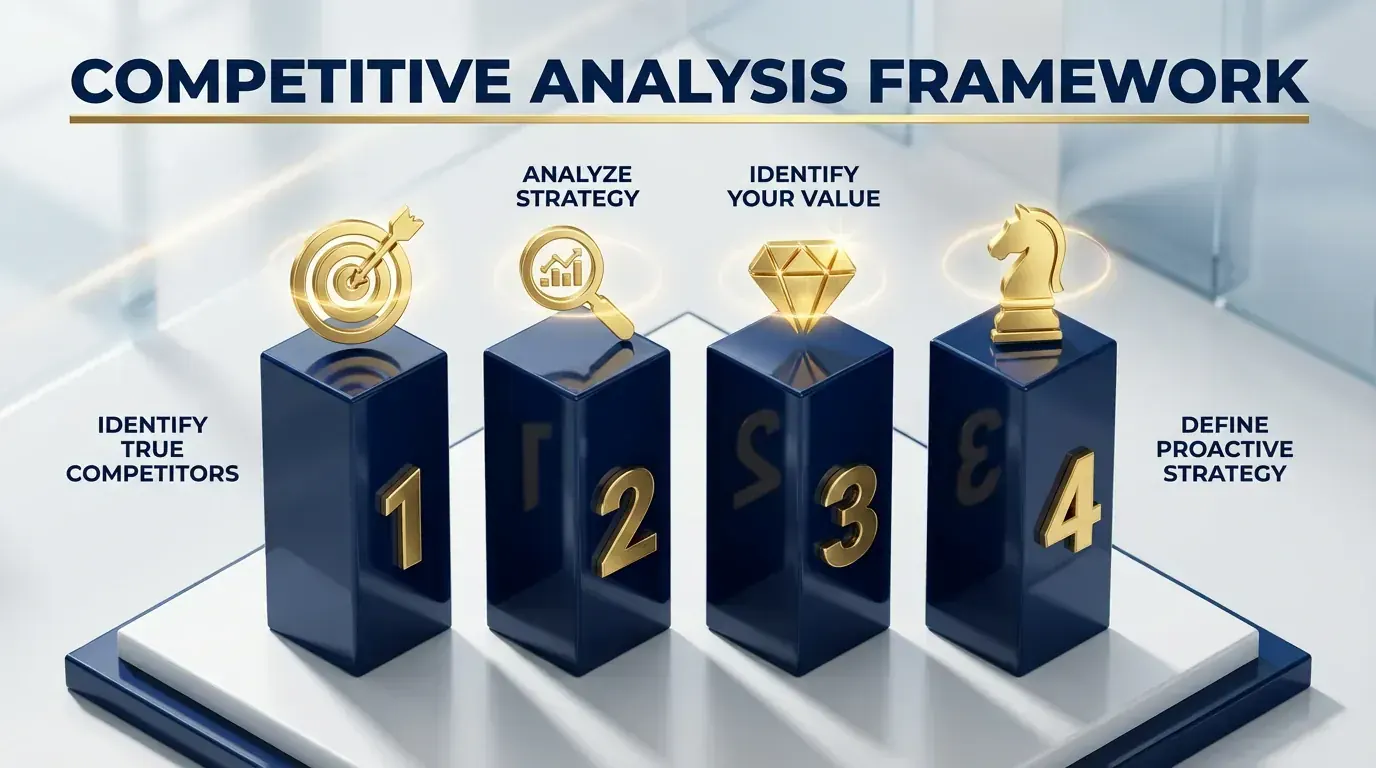
The Competitive Analysis Framework: A 4-Step System for Turning Insight into Action
This framework is designed to help you extract the signal from the noise and to use your understanding of the competitive landscape to build a more differentiated and defensible business.
| Step | Strategic Question | The Goal |
|---|---|---|
| 1. Identify Your True Competitors | Who are your customers really choosing between? | To focus your analysis on the competitors that actually matter. |
| 2. Analyze Their Strategy, Not Just Their Tactics | What is their underlying business model, value proposition, and target customer? | To understand the "why" behind their actions, not just the "what." |
| 3. Identify Your Differentiated Value | What is your unique and defensible advantage? | To articulate a clear and compelling reason for customers to choose you. |
| 4. Define Your Proactive Strategy | How will you leverage your differentiated value to win? | To translate your analysis into a concrete and actionable plan. |
1. Identify Your True Competitors: The Status Quo is Your Biggest Rival
Your most dangerous competitor is often not another startup. It is the status quo. It is the existing solution that your customers are using today, whether that is a spreadsheet, a manual process, or a legacy incumbent. You must have a clear and honest picture of who your customers are really choosing between. This includes direct competitors (who solve the same problem for the same customer), indirect competitors (who solve the same problem for a different customer), and substitutes (who solve the problem in a completely different way).
2. Analyze Their Strategy, Not Just Their Tactics: The Iceberg Model
A competitor's tactics (their pricing, their features, their marketing campaigns) are the tip of the iceberg. They are the visible manifestation of a much deeper underlying strategy. To truly understand your competitor, you must look below the surface. What is their business model? What is their core value proposition? Who is their ideal customer? What are their strengths and weaknesses? A deep understanding of your competitor's strategy will allow you to anticipate their moves and to identify the gaps in the market that you can exploit.
3. Identify Your Differentiated Value: The "Only We" Statement
Once you have a clear understanding of the competitive landscape, you must be able to articulate your unique and defensible advantage. A powerful way to do this is with an "Only We" statement. For example: "We are the only company that provides [your solution] for [your target customer] with [your unique differentiator]." A strong "Only We" statement is the cornerstone of a powerful competitive strategy.
4. Define Your Proactive Strategy: How Will You Win?
Competitive analysis is useless if it does not lead to action. The final step in the process is to translate your insights into a concrete and proactive strategy. How will you leverage your differentiated value to take market share? How will you exploit your competitors' weaknesses? How will you build a moat around your business that is difficult for others to cross? Your strategy should not be a reaction to your competitors; it should be a confident and proactive plan for dominating your chosen niche.
The Strategic Perspective: The Blue Ocean Strategy
The most powerful competitive strategy is to make the competition irrelevant. This is the core idea behind the "Blue Ocean Strategy." Instead of competing in a crowded and bloody "red ocean" of existing market space, a blue ocean strategy is about creating a new and uncontested market space. It is about finding a new group of customers, solving a new problem, or creating a new business model that renders the existing competition obsolete. This is the ultimate goal of a proactive and opportunity-focused approach to competitive analysis.
The Infinite Game: Your Customers are Your North Star
In the end, the best way to beat your competition is to stop obsessing over them and to start obsessing over your customers. Your customers are the ultimate source of truth. They are the ones who will tell you what matters, what is missing, and what they are willing to pay for. If you can build a business that is relentlessly focused on creating value for your customers, you will build a business that is very difficult for your competitors to beat.
Your competitors are a valuable source of data, but they are not your North Star. Your North Star is, and always will be, your customer. Follow them, and you will find your way to victory.