

The Strategic Compass: From Building a Product to Building a Market
You have poured your heart and soul into building an incredible product. You have obsessed over every feature, polished every pixel, and validated your solution with early users. You have built a better mousetrap. But a painful silence follows your launch. The flood of customers you expected is barely a trickle. The hockey-stick growth curve looks more like a flatline. This is the moment of truth for many founders, the moment they realize that a great product is not enough.
The core challenge is a pervasive and dangerous myth in the startup world: "If you build it, they will come." This myth leads founders to focus all their energy on product development while treating marketing and sales as an afterthought. The result is a world-class product with a third-class go-to-market strategy. The hard truth is that the world will not beat a path to your door. You must build that path yourself.
This article is a practical, step-by-step guide to developing and executing a go-to-market (GTM) strategy that will take your product from launch to your first $100K in revenue. It's about shifting your mindset from building a product to building a market for that product.
The Scrappy Founder's Dilemma: How to Win Without a Massive Budget
Most small businesses operate under a significant constraint: a lack of resources. You cannot afford to outspend your competitors on advertising or hire a massive sales team. This is not a weakness; it is a strategic advantage in disguise. Your lack of resources forces you to be creative, disciplined, and relentlessly focused on the activities that will generate the highest return on your limited time and money.
A successful GTM strategy for a small business is not about doing more; it is about doing the right things, in the right order.
The Go-to-Market Framework: A 5-Step Roadmap to Your First $100K
This framework is a cohesive system for turning your product into a revenue-generating machine.
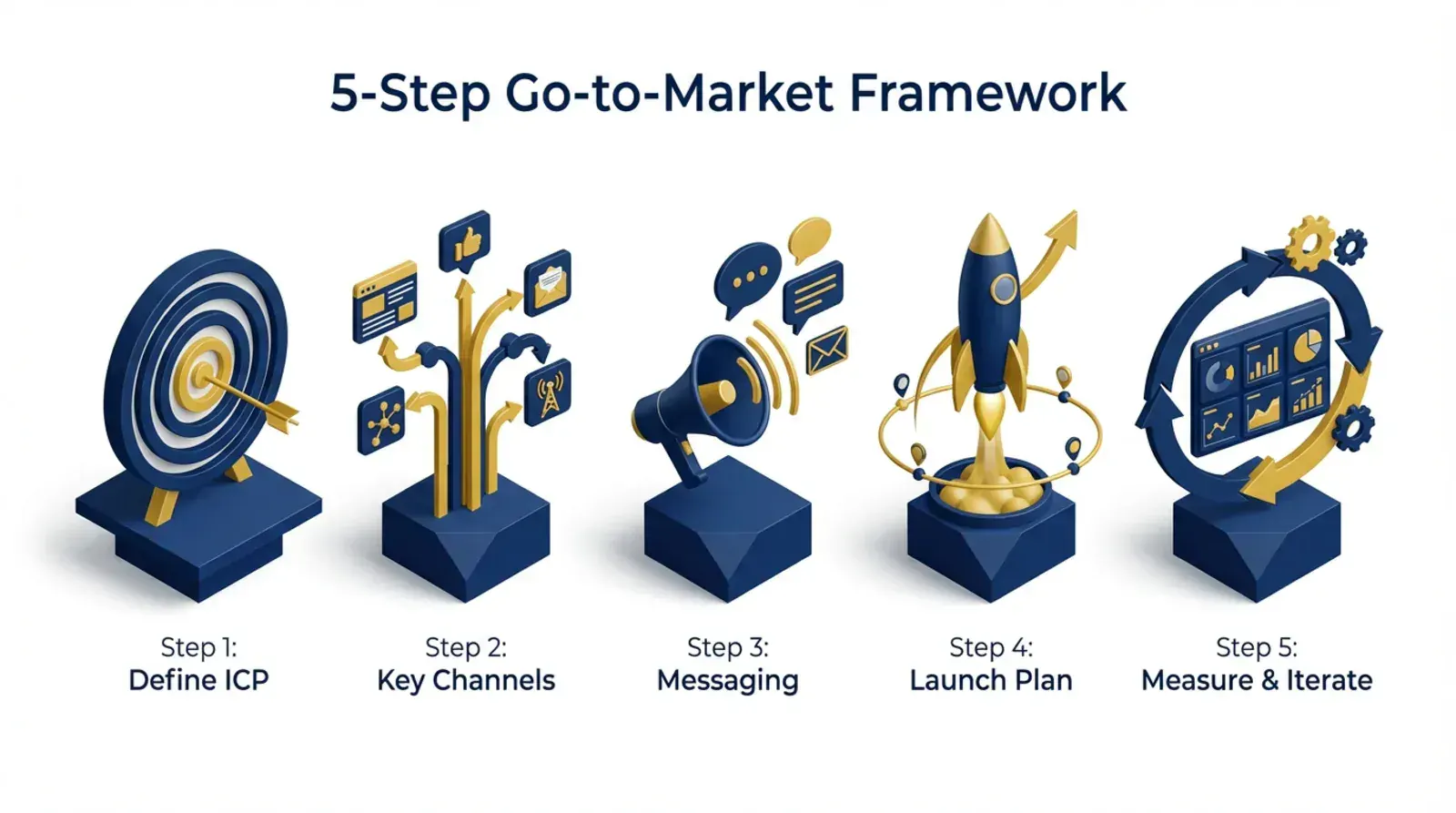
| Component | Strategic Question | The Goal |
|---|---|---|
| 1. Define Your ICP | Who is your Ideal Customer Profile, and what is their most painful problem? | To focus all your efforts on the people who are most likely to buy |
| 2. Identify Key Channels | Where do your ideal customers spend their time and look for solutions? | To find the most efficient and cost-effective path to your customers |
| 3. Develop Messaging | What is your unique and compelling story, and how do you tell it? | To craft a message that resonates deeply with your target audience |
| 4. Create a Launch Plan | What are the specific, sequenced actions you will take to launch? | To create a focused and executable plan that builds momentum |
| 5. Measure and Iterate | What is working, what is not, and how can you improve? | To create a tight feedback loop that accelerates your learning and growth |
1. Define Your Ideal Customer Profile (ICP): The Foundation of Everything
Your GTM strategy begins and ends with a deep, almost obsessive understanding of your ideal customer. Who are they? What is their job title? What industry are they in? What are their deepest frustrations? How do they make purchasing decisions? A vague ICP is the blueprint for a failed GTM strategy. A specific, detailed ICP is the foundation for a successful one.
Strategic Application: Instead of targeting "small businesses," a B2B SaaS company might target "project managers at creative agencies with 10-50 employees who are frustrated with the limitations of spreadsheets."
How to Build Your ICP:
- Demographics: Company size, industry, revenue, location
- Firmographics: Technology stack, growth stage, funding status
- Psychographics: Pain points, goals, decision-making process, budget authority
- Behavioral: How they research solutions, who influences their decisions, typical buying timeline
The more specific your ICP, the more focused and effective your GTM strategy will be. A narrow focus is not a limitation—it's a superpower.
2. Identify Your Key Channels: Go Where Your Customers Are
Once you know who you are targeting, you must figure out where to find them. Do not waste your time and money on every new marketing channel. For most early-stage businesses, the most effective channels are a combination of direct sales, content marketing, and strategic partnerships.
The Three High-ROI Channels for Small Businesses:
Direct Sales: Don't be afraid to sell. Direct outreach allows you to have priceless conversations with potential customers, understand their needs, and get immediate feedback on your messaging. This is especially powerful for B2B businesses where deal sizes justify personal attention.
- LinkedIn outreach to decision-makers
- Email sequences targeting your ICP
- Cold calling (yes, it still works when done right)
- Industry events and conferences
Content Marketing: Demonstrate your expertise and build trust by creating valuable content that helps your ICP solve their problems. This is not about selling; it is about serving. When you consistently provide value, customers come to you.
- Educational blog posts addressing your ICP's pain points
- Case studies showing real results
- How-to guides and frameworks
- Webinars and workshops
Strategic Partnerships: Who already has the trust and attention of your ideal customers? A strategic partnership can give you instant access to a qualified audience. This could be complementary product companies, industry associations, or influential thought leaders.
- Co-marketing campaigns with complementary products
- Integration partnerships
- Referral programs
- Guest appearances on podcasts or industry publications
3. Develop Your Messaging: Tell a Story That Resonates
Your messaging is the bridge between your product and your customer's problem. It must be clear, concise, and compelling. It must articulate the problem you solve, the solution you provide, and the transformation your customers can expect. Your messaging should be less about what your product is and more about what it does for your customer.
The Messaging Framework:
The Problem: What is the painful, expensive problem your ICP faces? Be specific. Use their language, not yours.
The Solution: How does your product solve this problem? Focus on outcomes, not features.
The Transformation: What does life look like after they use your product? Paint a picture of the future state.
The Proof: Why should they believe you? Use customer testimonials, case studies, and data.
The Call to Action: What is the specific next step you want them to take?
Example: Instead of "We're a project management tool with Kanban boards," say "Stop losing track of client projects in messy spreadsheets. Get your team on the same page with a visual workflow that actually works—without the complexity of enterprise tools."
4. Create Your Launch Plan: From Strategy to Action
Your launch plan is the tactical execution of your GTM strategy. It is a detailed, time-bound plan that outlines the specific actions you will take to generate your first wave of customers. A good launch plan is focused and realistic. It doesn't try to do everything at once. It focuses on a small number of high-leverage activities and executes them with excellence.
The 30-Day Launch Roadmap:
Week 1 - Pre-Launch Preparation:
- Finalize your ICP and create a list of 100 target companies/individuals
- Create your core messaging (website copy, email templates, pitch deck)
- Set up tracking and analytics
- Prepare launch content (blog posts, social posts, case studies)
Week 2 - Soft Launch to Early Adopters:
- Reach out to your warm network (past customers, advisors, early users)
- Offer exclusive early access or founding member pricing
- Conduct customer interviews to gather testimonials
- Refine messaging based on feedback
Week 3 - Public Launch:
- Publish launch content across all channels
- Start outbound outreach to your target list
- Activate partnership channels
- Host launch webinar or event
Week 4 - Follow-Up and Optimization:
- Follow up with all leads and prospects
- Analyze what's working and what's not
- Double down on highest-performing channels
- Plan next 30-day sprint
5. Measure and Iterate: The Feedback Loop of Growth
Your initial GTM strategy is a set of educated guesses. The market will quickly tell you which of those guesses are right and which are wrong. You must be religious about tracking your key metrics: Customer Acquisition Cost (CAC), conversion rates, and sales cycle length. This data is the voice of the market. Listen to it, learn from it, and iterate on your strategy accordingly.
The Essential GTM Metrics:
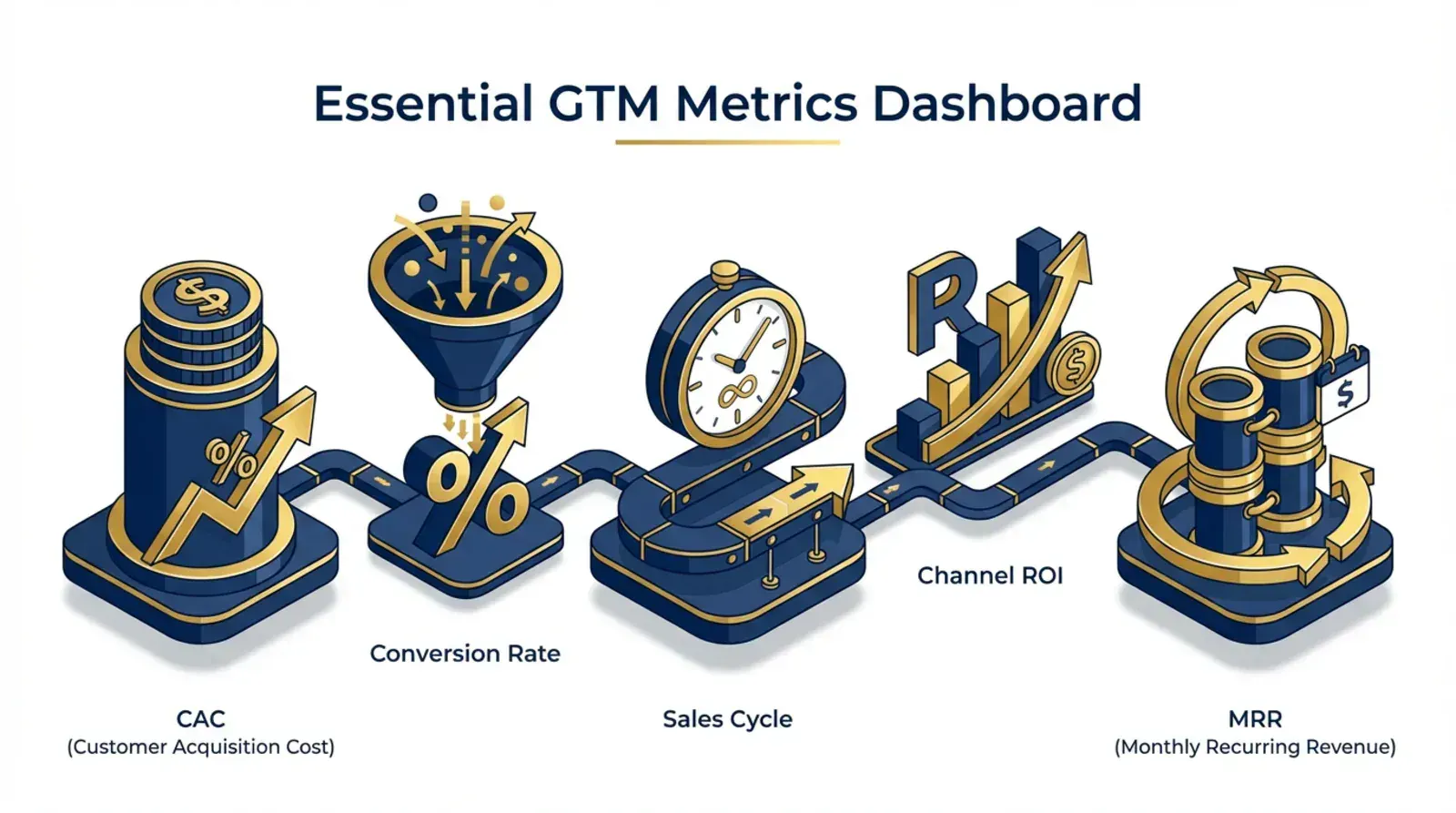
| Metric | What It Measures | Target (Early Stage) |
|---|---|---|
| Customer Acquisition Cost (CAC) | Total cost to acquire one customer | < 30% of Customer Lifetime Value |
| Conversion Rate | % of leads that become customers | 2-5% for outbound, 10-20% for inbound |
| Sales Cycle Length | Time from first contact to closed deal | Shorter is better; track and reduce |
| Channel ROI | Revenue generated per channel investment | At least 3:1 to be sustainable |
| Monthly Recurring Revenue (MRR) | Predictable monthly revenue | $8-10K MRR = $100K annual run rate |
The Weekly Review Ritual: Every week, review your numbers. What's working? What's not? Where should you invest more time? What should you stop doing? This discipline of measurement and iteration is what separates successful GTM strategies from failed ones.
The Strategic Perspective: The Myth of the Perfect Launch
There is no such thing as a perfect launch. Your launch is not the finish line; it is the starting line. It is the beginning of a long process of learning, iterating, and improving. The goal of your launch is not to achieve overnight success; it is to generate the data and the insights you need to build a scalable and repeatable growth engine.
The most successful founders don't have the best initial strategy—they have the fastest learning loop. They launch, measure, learn, adjust, and launch again. This cycle of continuous improvement is what transforms a decent product into a market-dominating business.
Real-World Example: From $0 to $100K in 6 Months
A B2B SaaS startup targeting creative agencies followed this framework:
- ICP: Project managers at 20-50 person creative agencies frustrated with client communication chaos
- Channels: LinkedIn outreach (50 messages/day) + Educational blog content + Partnerships with agency associations
- Messaging: "Stop losing clients to miscommunication. One platform for proposals, feedback, and approvals."
- Launch: 30-day focused sprint, starting with 20 warm leads from network
- Results: 12 customers in month 1 at $500/mo = $6K MRR. Doubled every 6 weeks. Hit $100K ARR in month 6.
The key? They didn't try to do everything. They picked three channels, executed them with discipline, and iterated based on what worked.
The Infinite Game: Your Go-to-Market Strategy as a Living System
A GTM strategy is not a static document that you create once and then file away. It is a living, breathing system that must be constantly monitored, tweaked, and optimized. The founders who win are not the ones with the most brilliant initial strategy, but the ones who are the fastest to learn and adapt.
Building a successful business is not just about building a great product. It is about building a great go-to-market machine. It is about having the discipline to move beyond the comfort of product development and embrace the messy, challenging, and ultimately rewarding work of building a market.