

The Strategic Compass: From Early Traction to Enduring Fit
Product-market fit (PMF) is the holy grail of the startup world. It is the mythical state where your product and your market are in perfect harmony, where growth becomes effortless, and where customers are beating a path to your door. It is the promised land that every founder is striving to reach. It is also one of the most misunderstood, misdiagnosed, and misused concepts in the entire startup lexicon.
The core challenge is that most founders are desperate to believe they have achieved PMF. They mistake early traction for enduring fit. They confuse the enthusiasm of a few early adopters with the validation of a scalable market. They declare victory too soon, and in doing so, they make a fatal strategic error: they hit the accelerator on a business that is not yet ready for the speed.
This article is a strategic intervention. It is a founder's guide to cutting through the self-deception and the vanity metrics to understand what product-market fit really is, how to measure it, and how to know when you have truly found it. It's about replacing wishful thinking with a rigorous, data-driven framework for assessing the true health of your business.
The Danger of a False Positive: Why Premature Scaling is a Death Sentence
Scaling a business before you have achieved true product-market fit is like building a skyscraper on a foundation of sand. It may look impressive for a while, but it is destined to collapse. When you prematurely scale, you pour money into a sales and marketing engine that is not yet efficient. You hire people you don't yet need. You build processes for a business model that is not yet proven. It is the single fastest way to burn through your cash and kill your company.
To avoid this fate, you must be brutally honest with yourself. You must be willing to confront the data, even when it tells you a story you don't want to hear. You must have a clear and objective way to measure your progress toward product-market fit.
The Product-Market Fit Framework: 5 Unmistakable Signals
Product-market fit is not a feeling; it is a series of observable, measurable signals. When you have achieved PMF, you don't need to ask if you have it. The market will tell you, loudly and clearly. These are the five signals you should be listening for.
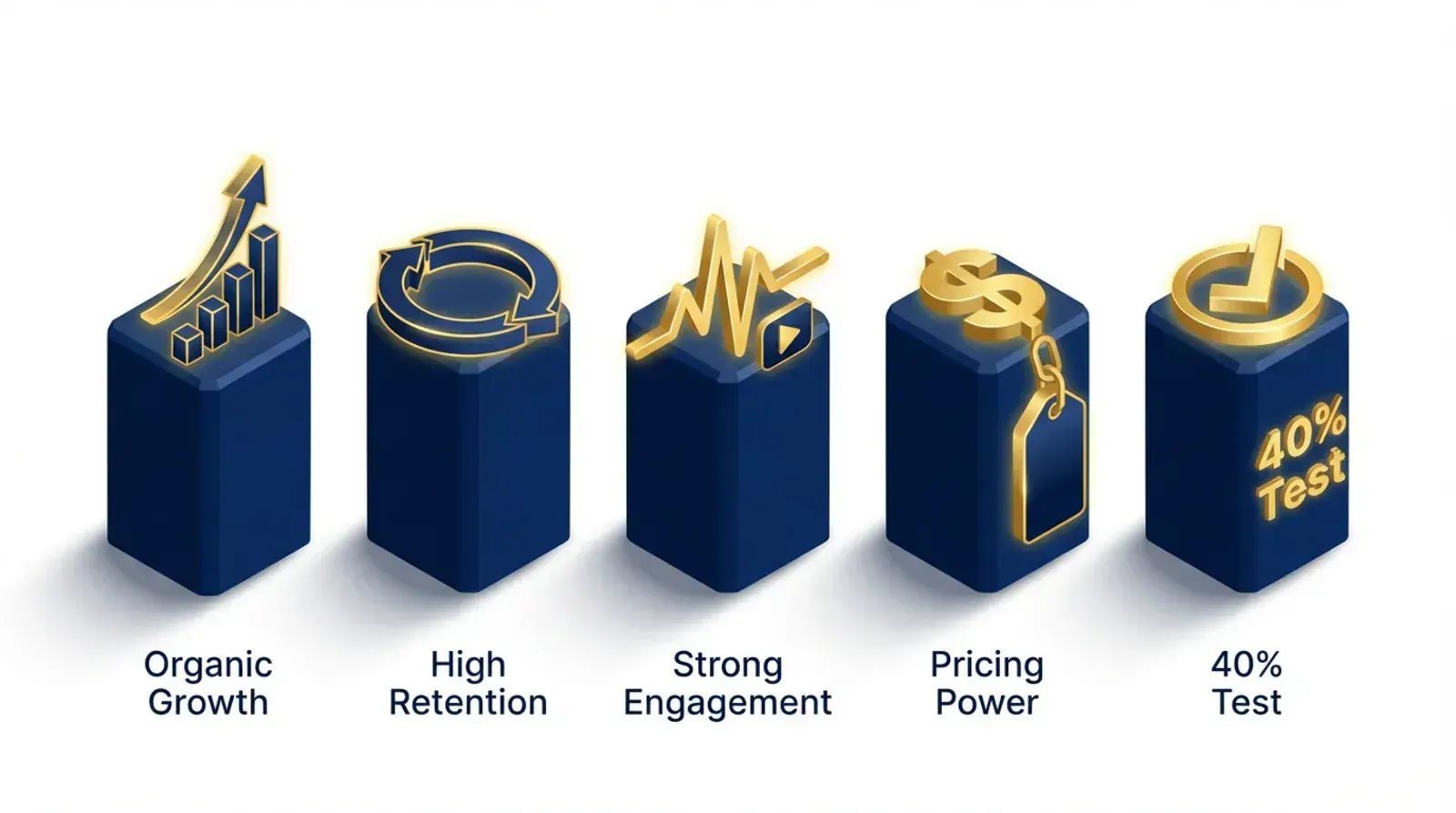
| Signal | The Question It Answers | The Litmus Test |
|---|---|---|
| 1. Strong Organic Growth | Are customers seeking you out? | A significant percentage of your growth is coming from word-of-mouth, referrals, and organic search |
| 2. High Retention | Are customers staying with you? | Your churn rate is low and your retention cohorts are smiling |
| 3. Strong Engagement | Are customers actively using your product? | Your daily, weekly, and monthly active user counts are healthy and growing |
| 4. Willingness to Pay | Are customers willing to pay a premium? | You can raise your prices without a significant increase in churn |
| 5. The "How Would You Feel?" Test | Would users be very disappointed if your product disappeared? | At least 40% of your users say they would be "very disappointed" |
1. The Pull of Organic Growth: Are You Pushing or Being Pulled?
A business without PMF has to push its product onto the market. A business with PMF is pulled by the market. The clearest sign of this pull is strong organic growth. If the majority of your new customers are coming from paid advertising, you are still in the pushing phase. If a significant and growing percentage of your new customers are coming from word-of-mouth, referrals, and organic search, you are starting to feel the pull.
Strategic Application: Track your customer acquisition sources weekly. When organic channels (referrals, word-of-mouth, organic search) consistently account for more than 40% of new customers, you're moving toward PMF.
2. The Power of Retention: The Silent Killer of Startups
Churn is the silent killer of startups. It is the leaky bucket that will drain your business of its lifeblood, no matter how fast you pour new customers in. High retention is the single strongest signal of product-market fit. It is the ultimate validation that you have built something that customers truly value. For a B2B SaaS business, a healthy monthly churn rate is typically below 3%. For a B2C business, it is typically below 5%.
Strategic Application: Build retention cohort charts. If your 6-month retention rate is above 80% for B2B (or 40% for B2C), you have a product people want to keep.
3. The Habit of Engagement: Is Your Product a Vitamin or a Painkiller?
Is your product a nice-to-have or a must-have? The answer lies in your engagement metrics. Are your customers using your product on a daily, weekly, or monthly basis? Is it becoming a part of their workflow, a habit they can't live without? A product with high engagement is a product that has become a painkiller, not just a vitamin.
Strategic Application: Define your "magic moment"—the action that leads to long-term retention. Measure how quickly new users reach this moment and how frequently they return to it.
4. The Litmus Test of Pricing Power: Are You Competing on Value or Price?
A product with strong PMF has pricing power. This means you can charge a premium price for the value you deliver, and customers will happily pay it. If you are constantly getting into price wars with your competitors, if you have to offer deep discounts to close deals, you have not yet achieved true product-market fit. You are competing on price, not on value.
Strategic Application: Test a 10-20% price increase with a segment of new customers. If churn doesn't spike significantly, you have pricing power—a strong PMF indicator.
5. The Sean Ellis Test: The Voice of the Customer
Sean Ellis, the co-author of "Hacking Growth," developed a simple but powerful survey to measure product-market fit. Ask your users: "How would you feel if you could no longer use our product?" The possible answers are: (a) Very disappointed, (b) Somewhat disappointed, or (c) Not disappointed. If at least 40% of your users say they would be "very disappointed," you have a strong signal of product-market fit.
Strategic Application: Survey your active users quarterly. Track this metric over time. When you consistently hit 40%+ "very disappointed," you've crossed the PMF threshold.
The Strategic Perspective: Product-Market Fit is a Journey, Not a Destination
Product-market fit is not a static, one-time achievement. It is a dynamic state that must be constantly nurtured and defended. Markets change, competitors emerge, and customer expectations evolve. The disciplined founder is never complacent. They are constantly listening to their customers, iterating on their product, and working to deepen the fit between what they offer and what the market needs.
The PMF Maintenance Checklist:
- Monthly Customer Interviews: Talk to at least 10 customers per month—both happy and churned
- Quarterly Sean Ellis Surveys: Track your "very disappointed" percentage
- Weekly Metrics Review: Monitor retention, engagement, and organic growth
- Competitive Analysis: Stay aware of how competitors are evolving
- Product Iteration: Ship improvements based on customer feedback, not assumptions
The Infinite Game: The Enduring Power of a Perfect Fit
The pursuit of product-market fit is the most important journey a founder will ever undertake. It is a journey that requires patience, humility, and a relentless focus on the customer. It is a journey that is often frustrating and rarely linear. But for those who have the discipline and the resilience to see it through, the reward is immense.
It is the reward of building a business that is not just growing, but is built to last. It is the reward of creating something that the world truly needs. And it is the foundation upon which all sustainable growth is built.