

The Strategic Compass: From Cost-Plus to Value-Based Pricing
Pricing is the most powerful and least understood lever of profitability in any business. For most founders, it is a source of deep anxiety and confusion. We underprice our products out of fear, we overprice them out of arrogance, and we default to simplistic cost-plus models because we lack the confidence to do anything else. The result is a catastrophic loss of value. We leave money on the table, we attract the wrong customers, and we undermine the perceived value of our product.
The core challenge is that most founders view pricing as a mathematical problem, when in fact, it is a strategic and psychological one. It is not about what your product costs to build; it is about what it is worth to your customer. It is about having the courage to charge for the value you create.
This article is a founder's guide to mastering the art and science of pricing. It is a strategic framework for moving beyond the false comfort of cost-plus pricing and embracing a value-based approach that will transform the profitability of your business.
The Pricing Paradox: Why Lowering Your Price Can Hurt You
In the absence of any other signal, price is a powerful proxy for quality. A low price can signal a lack of confidence, a commodity product, or a desperate founder. A premium price, on the other hand, can signal quality, exclusivity, and a deep understanding of the value you provide. The pricing paradox is that by lowering your price, you may actually be making your product less attractive to your ideal customers.
To escape this paradox, you must anchor your pricing not in your costs, but in the value you deliver.
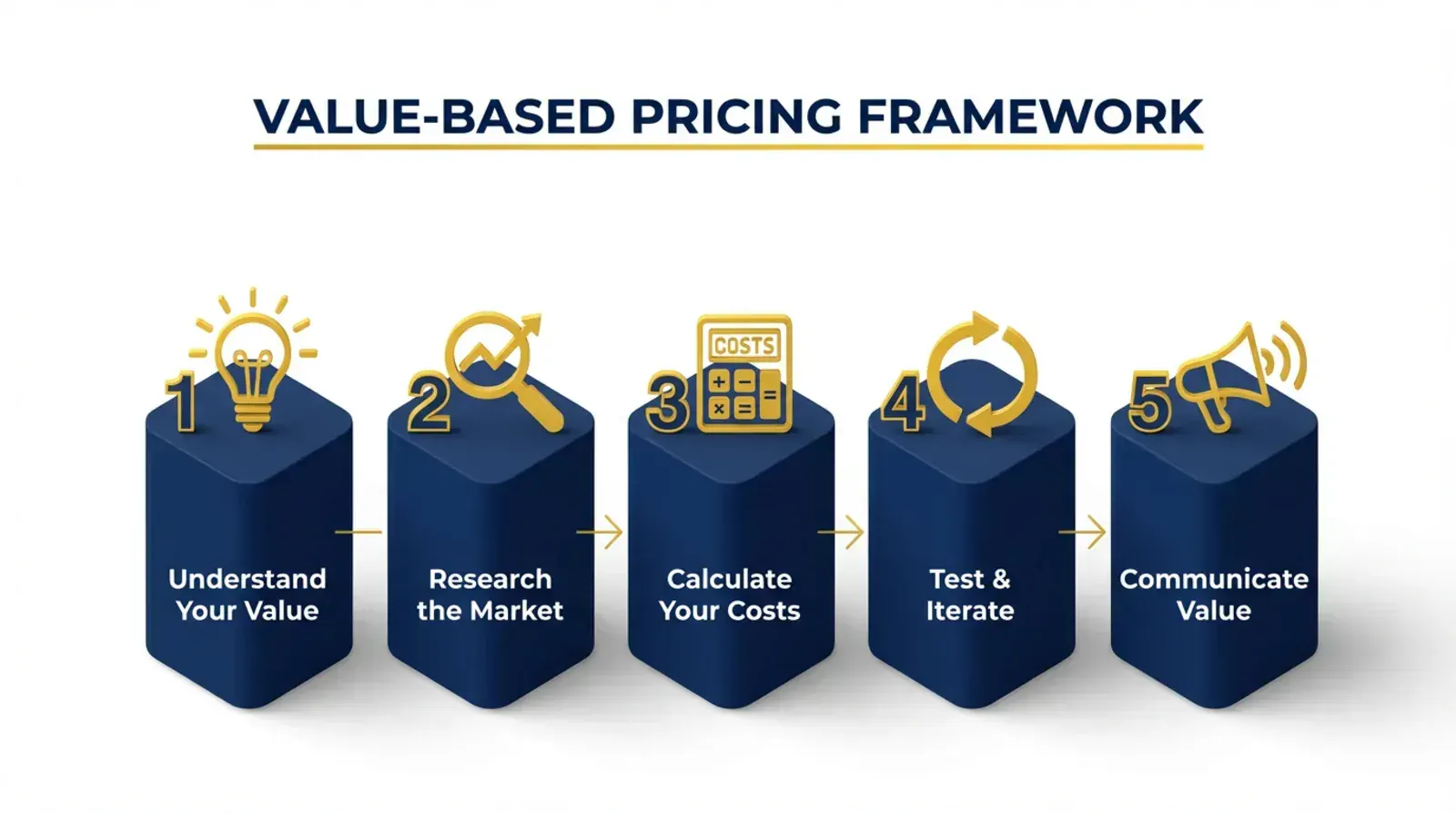
The Value-Based Pricing Framework: 4 Steps to Pricing with Confidence
This framework is a disciplined process for uncovering the true value of your product and capturing a fair share of that value in your pricing.
| Step | Strategic Question | The Goal |
|---|---|---|
| 1. Understand Your Customer | What is the economic, emotional, and strategic value your product creates for your customer? | To anchor your price in the customer's ROI, not your costs. |
| 2. Understand Your Market | How are your competitors priced, and what is their value proposition? | To position your product effectively in the competitive landscape. |
| 3. Choose Your Pricing Model | What is the most effective way to package and sell your value? | To align your pricing model with your customer's workflow and your business goals. |
| 4. Test and Iterate | How can you use data and experimentation to optimize your pricing over time? | To treat pricing as a dynamic system, not a static decision. |
1. The Foundation of Value: Your Customer's ROI
Your price is a reflection of the value you create. Before you can set a price, you must have a deep and quantitative understanding of that value. How much time does your product save your customer? How much money does it make them? How does it reduce their risk? How does it make them feel? You must be able to articulate a compelling and quantifiable ROI story for your product.
2. The Competitive Landscape: A Guide, Not a Dictator
Understanding how your competitors are priced is important, but it should not be the primary driver of your pricing strategy. Your competitors' pricing is a data point, not a directive. Use it to understand the market conventions and to inform your positioning, but do not let it dictate your price. If you have a superior product that delivers more value, you should have a superior price.
3. The Architecture of Your Price: Choosing the Right Model
How you charge is often as important as how much you charge. The right pricing model can reduce friction, increase adoption, and align your incentives with those of your customers. Common pricing models for SaaS businesses include:
- Flat-Rate Pricing: A single price for a single product.
- Tiered Pricing: Multiple packages with different features and price points.
- Usage-Based Pricing: The price is based on how much the customer uses the product.
- Per-User Pricing: The price is based on the number of users on the account.
The right model for your business will depend on your product, your customers, and your business goals.
4. The Discipline of Experimentation: Pricing is a Process, Not a Project
Your initial pricing is a hypothesis. It is an educated guess that must be tested and validated with real-world data. The most successful companies treat pricing as a dynamic system that is constantly being monitored, tested, and optimized. Use A/B testing, cohort analysis, and customer surveys to understand the impact of your pricing decisions and to identify opportunities for improvement.
The Strategic Perspective: The Courage to Charge What You're Worth
Pricing is an act of courage. It is the courage to believe in the value of your product. It is the courage to say "no" to the customers who are not a good fit. And it is the courage to charge a price that reflects the blood, sweat, and tears you have poured into building your business. The fear of pricing too high is one of the most destructive forces in the startup world. It is a self-fulfilling prophecy that leads to a vicious cycle of underpricing, undervaluing, and under-investing.
The Infinite Game: Your Price as a Statement of Your Brand
Your pricing is a powerful statement about your brand. It is a signal to the market about who you are, what you stand for, and the value you create. A low price signals that you are competing on cost. A premium price signals that you are competing on value. There is no right or wrong answer, but you must be intentional about the signal you are sending.
Mastering the discipline of pricing is one of the most important journeys a founder can take. It is a journey that will force you to have a deeper understanding of your customers, your market, and the true value of what you have created. It is a journey that will transform the profitability and the sustainability of your business.