

In the theater of startups, founders are taught to worship at the altar of growth. We celebrate rising revenues, growing user counts, and ever-expanding market share. But behind the curtain of this growth-at-all-costs narrative, a dangerous illusion is being spun.
The Strategic Compass: From Vanity Metrics to Sustainable Profitability
A business can have millions in revenue and still be a leaky bucket, losing money on every single customer it acquires. It can have thousands of users and be on a fast track to bankruptcy.
The core challenge is that most founders are seduced by the allure of top-line growth and remain willfully ignorant of the numbers that actually determine the health and viability of their business: unit economics.
Unit economics are the brutal, unforgiving mathematics of your business model. They answer a simple but profound question: for every customer you acquire, are you making money or losing it?
This article is a founder's guide to mastering the most important numbers in your business. It is a strategic framework for moving beyond the vanity of top-line growth and building a business that is not just scalable, but sustainable and profitable. It's about understanding if you are building a business or an expensive hobby.
The Uncomfortable Truth: Your Growth Story Might Be a Lie
The reason so many founders avoid a deep dive into their unit economics is that they are afraid of what they might find. It is much more comfortable to believe in the simple story of "growth is good" than to confront the complex reality of customer acquisition costs, lifetime value, and churn rates.
But ignorance is not a strategy. A failure to understand your unit economics is a failure to understand your business.
To build a truly sustainable business, you must master the five key metrics that govern your profitability.
The 5 Key Metrics of Unit Economics
These metrics are not just numbers on a spreadsheet; they are the vital signs of your business. They tell you whether you have a viable business model or a ticking time bomb.
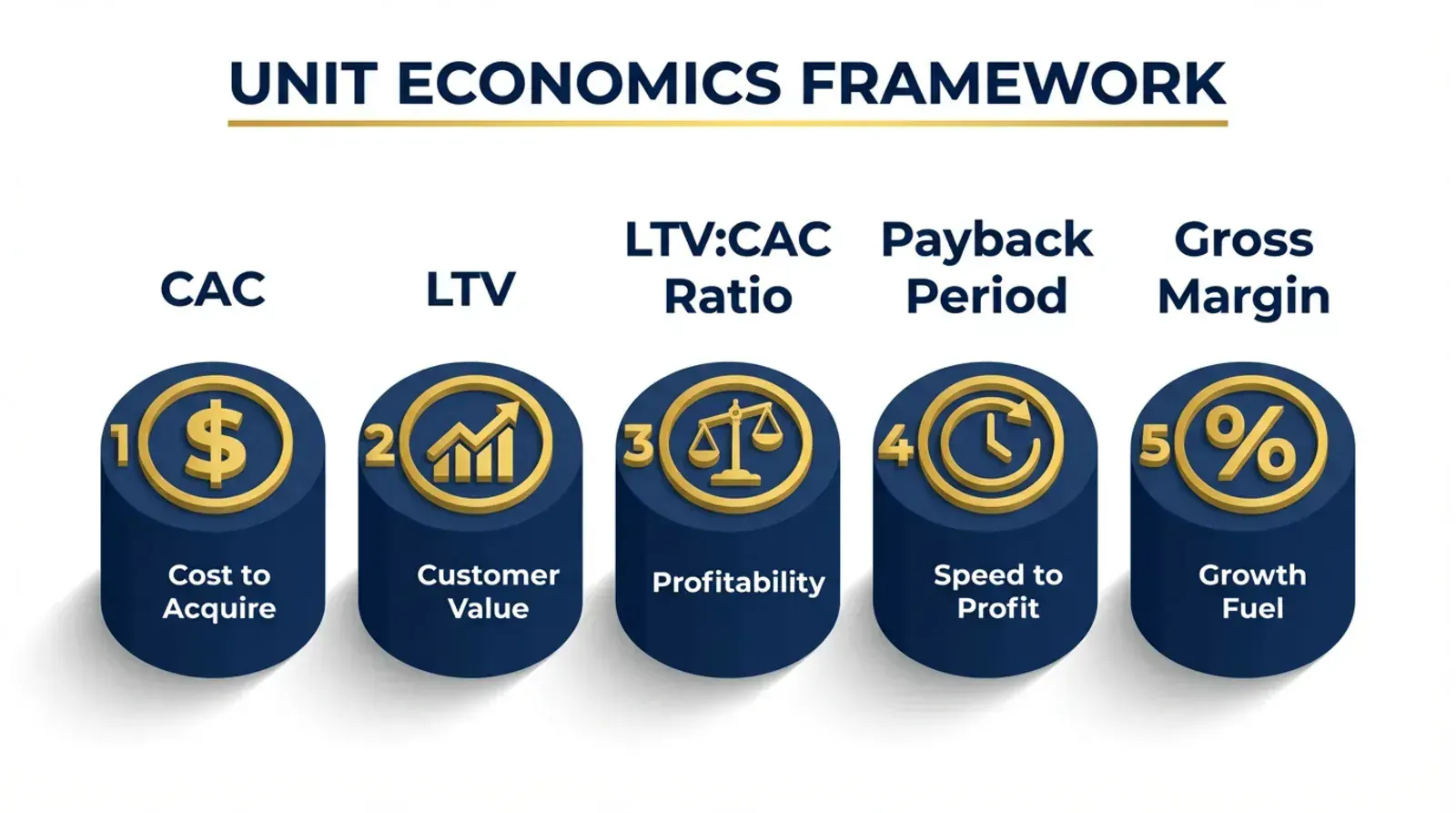
| Metric | The Question It Answers | Why It Matters |
|---|---|---|
| 1. CAC | How much does it cost to acquire a new customer? | Determines the efficiency of your sales and marketing engine. |
| 2. LTV | How much profit will a customer generate over their entire relationship with you? | Defines the upper limit of what you can afford to spend on CAC. |
| 3. LTV:CAC Ratio | For every dollar you spend on acquisition, how many dollars of profit do you get back? | The ultimate measure of the profitability of your growth model. |
| 4. Payback Period | How many months does it take to earn back the cost of acquiring a customer? | A critical measure of your capital efficiency and cash flow health. |
| 5. Gross Margin | What percentage of your revenue is left after paying for the direct costs of serving your customers? | The fuel for your growth engine. |
1. Customer Acquisition Cost (CAC): The Cost of Growth
Your CAC is the total cost of your sales and marketing efforts divided by the number of new customers you acquired in a given period. Be brutally honest in this calculation. Include salaries, ad spend, software costs, and any other expense related to customer acquisition.
A low CAC is a sign of an efficient growth engine. A high CAC is a warning sign that your growth may be unprofitable.
2. Customer Lifetime Value (LTV): The Value of a Customer
Your LTV is the total profit you can expect to generate from a single customer over the entire duration of their relationship with your business. It is a function of your average revenue per customer and your customer churn rate.
A high LTV is the reward for creating a product that customers love and a brand they trust.
3. The LTV:CAC Ratio: The Golden Metric
The ratio of your LTV to your CAC is the single most important metric for understanding the long-term viability of your business. A healthy LTV:CAC ratio for a SaaS business is generally considered to be 3:1 or higher.
This means that for every dollar you spend to acquire a customer, you can expect to get at least three dollars back in profit. A ratio of less than 3:1 is a sign that you are paying too much for growth.
4. Payback Period: The Speed of Profitability
Your payback period is the number of months it takes to recoup your CAC. A shorter payback period means you are more capital-efficient and can reinvest your profits back into growth more quickly.
For a SaaS business, a payback period of 12 months or less is considered healthy. A payback period of over 18 months can put a significant strain on your cash flow.
5. Gross Margin: The Fuel for Your Business
Your gross margin is the percentage of revenue you have left after accounting for the direct costs of serving your customers (e.g., hosting costs, raw materials, support staff).
A high gross margin means you have more money to invest in product development, sales, and marketing. A low gross margin can starve your business of the fuel it needs to grow.
The Strategic Perspective: The Danger of Premature Scaling
The most dangerous mistake a founder can make is to scale a business with broken unit economics. Pouring money into a sales and marketing engine with a LTV:CAC ratio of 1:1 is like pouring gasoline on a fire.
You will create the illusion of growth, but you will be burning through cash and destroying value with every new customer you acquire.
The disciplined founder does not scale until they have achieved healthy unit economics. They focus on profitability first, then growth.
The Infinite Game: Unit Economics as Your North Star
Your unit economics are not a static snapshot; they are a dynamic system that you must constantly monitor and optimize. They are the North Star that should guide every strategic decision you make, from pricing to product development to marketing spend.
The founders who build enduring, profitable businesses are not the ones who grow the fastest, but the ones who have the deepest understanding of the fundamental mathematics of their business.
It is time to move beyond the vanity of growth for growth's sake. It is time to embrace the discipline of unit economics. It is time to build a business that is not just growing, but is built to last.
Ready to master your unit economics?
Book Your Strategic Session