

The Strategic Compass: Are You Sourcing a Product or a Partnership?
For many founders, the decision to source from China is driven by a single, powerful motivator: cost. The promise of significantly lower manufacturing prices is a siren song that is difficult to resist. But for every story of a successful product launch, there is a cautionary tale of a founder who has been burned by a sourcing nightmare. The dream of a low-cost supply chain can quickly turn into a reality of missed deadlines, poor quality, and outright scams.
The core problem is a fundamental misalignment of expectations. Many founders approach sourcing as a purely transactional activity. They are looking for a supplier to produce a product at the lowest possible price. They are not looking for a partner. This transactional mindset is the root cause of most sourcing failures. It creates a dynamic where both sides are incentivized to cut corners, hide information, and exploit any perceived weakness.
This article provides a strategic framework for moving beyond the transactional mindset and building a resilient, high-quality supply chain. It is a 7-step vetting process designed to help you identify and cultivate long-term, strategic partnerships with reliable suppliers in China. It's about replacing the gamble of transactional sourcing with the security of a trusted partnership.
The Asymmetry of Information: Why Sourcing from China is So Risky
The fundamental challenge of sourcing from China is the asymmetry of information. As a founder on the other side of the world, you are at a significant disadvantage. You cannot easily verify a supplier's claims, inspect their facilities, or monitor their production processes. This information gap creates a fertile ground for misunderstandings, quality issues, and fraud.
To close this gap, you must adopt a systematic and disciplined approach to vetting your suppliers. You must move from a position of blind trust to one of earned trust. This is not about being cynical; it is about being a prudent and responsible business owner.
The 7-Step Vetting Process for Finding Trustworthy Manufacturing Partners
This is not a checklist to be completed; it is a disciplined process to be followed. Each step builds upon the last to create a comprehensive picture of a supplier's capabilities, reliability, and trustworthiness.
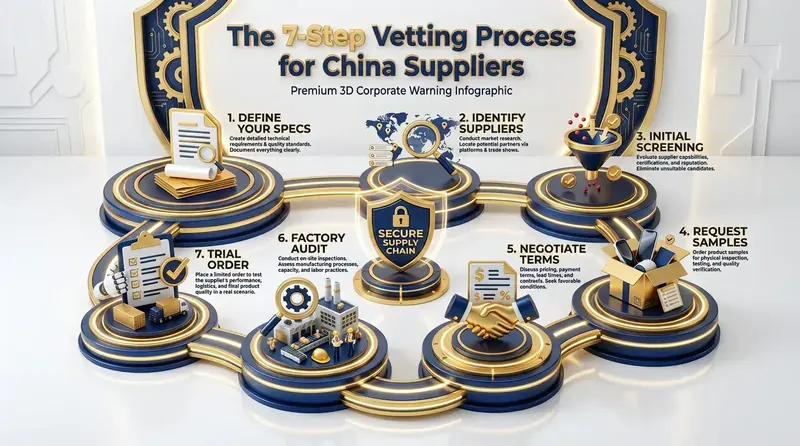
| Step | Strategic Action | The Question You Are Answering |
|---|---|---|
| 1. Define Your Specs | Create a detailed, unambiguous Product Specification Sheet. | "Do I know exactly what I want to build?" |
| 2. Identify Suppliers | Use a multi-channel approach to build a long list of potential suppliers. | "Have I cast a wide enough net?" |
| 3. Initial Screening | Conduct a thorough background check on your top candidates. | "Is this a legitimate and professional business?" |
| 4. Request Samples | Order and meticulously evaluate product samples. | "Can this supplier meet my quality standards?" |
| 5. Negotiate Terms | Structure a fair and mutually beneficial agreement. | "Is this a partnership or a one-sided transaction?" |
| 6. Conduct a Factory Audit | Perform an on-site inspection of the supplier's facilities. | "Do their operations match their promises?" |
| 7. Place a Trial Order | Start with a small, low-risk order to test the entire system. | "Can this supplier deliver on time and to spec?" |
1. The Foundation of a Successful Partnership: A Flawless Spec Sheet
Before you can find the right supplier, you must have an unshakeable understanding of what you are building. Your Product Specification Sheet is the single most important document in the sourcing process. It must be detailed, precise, and unambiguous. It should leave no room for interpretation. A great spec sheet is the foundation of a great partnership.
2. Building Your Long List: Beyond Alibaba
While platforms like Alibaba and Global Sources are a good starting point, they should not be your only source of potential suppliers. The best suppliers are often not the best at online marketing. Attend industry trade shows, ask for referrals from other founders, and consider using a reputable sourcing agent to help you identify high-quality suppliers that are not on the major platforms.
3. The Initial Background Check: Separating the Contenders from the Pretenders
Once you have a long list of potential suppliers, you must begin the process of due diligence. This is not a cursory check. You must verify their business license, check their litigation history, and look for any red flags in their online presence. A professional business will have a professional footprint. A business with a history of legal trouble is a business to avoid.
4. The Moment of Truth: The Product Sample
A product sample is your first tangible piece of evidence about a supplier's capabilities. Do not cut corners on this step. Pay for the samples, pay for the shipping, and then subject them to a rigorous evaluation. Does the quality match your spec sheet? Is the finishing up to standard? Is the packaging professional? The sample is a proxy for the final product. If the sample is not perfect, the bulk order will be a disaster.
5. Structuring the Deal: The Art of the Win-Win Negotiation
Negotiation is not a battle to be won; it is a collaboration to be structured. Your goal is to create an agreement that is fair, sustainable, and mutually beneficial. A typical payment structure is 30% upfront, with the remaining 70% due upon successful completion of a pre-shipment inspection. A supplier who demands 100% upfront is a supplier you should walk away from.
6. Seeing is Believing: The Factory Audit
For any significant order, a factory audit is a non-negotiable step. If you cannot be there yourself, hire a reputable third-party inspection company to go on your behalf. An audit will verify the supplier's claims about their facilities, their equipment, and their quality control processes. It is the single best way to protect yourself from a catastrophic quality failure.
7. The Final Test: The Trial Order
A trial order is your final opportunity to test the entire system before you commit to a large volume order. It allows you to evaluate the supplier's communication, their adherence to deadlines, and their ability to consistently produce a quality product. A successful trial order is the final green light in a long and disciplined vetting process.
The Strategic Perspective: The True Cost of a "Cheap" Supplier
The relentless pursuit of the lowest possible price is the single biggest mistake a founder can make in the sourcing process. A "cheap" supplier will always cost you more in the long run. They will cost you in the form of delays, defects, and damage to your brand's reputation. The smart founder does not look for the cheapest supplier; they look for the best value. They look for a partner who can deliver a quality product, on time, and at a fair price.
The Infinite Game: Your Supply Chain as a Strategic Asset
In the end, your supply chain is a reflection of your company's values. A supply chain built on transactional relationships and the exploitation of information asymmetry is a fragile and vulnerable thing. A supply chain built on a foundation of trust, transparency, and mutual respect is a powerful and enduring strategic asset.
The choice is yours. Will you be a transactional sourcer, forever chasing the lowest price and living in fear of the next disaster? Or will you be a strategic partner, investing the time and effort to build a supply chain that is as resilient and as well-crafted as the product you are bringing to the world?