

In the traditional playbook of business growth, there is a simple and seductive equation: more growth requires more people. This "scaling by addition" model is deeply ingrained in our thinking. It is also a trap.
The Strategic Compass: From Scaling by Addition to Scaling by Multiplication
When you need to scale your sales, you hire more salespeople. When you need to scale your marketing, you hire more marketers. This leads to bloated payrolls, increased complexity, and diminishing returns. It is a linear and inefficient way to grow.
The core challenge is that most founders have a limited view of the levers of scale. They are so focused on the internal resources they can control (i.e., the people they can hire) that they lose sight of the vast and powerful ecosystem of external resources they could be leveraging.
The most powerful and capital-efficient way to scale your business is not by hiring more people, but by building strategic partnerships.
This article is a founder's guide to moving beyond the linear logic of scaling by addition and embracing the exponential power of scaling by multiplication. It is a strategic framework for identifying, building, and nurturing the partnerships that can transform the trajectory of your business.
The Partnership Multiplier: 1 + 1 = 10
A strategic partnership is not a simple transactional relationship. It is a deep and collaborative alignment between two companies that are committed to creating mutual value. A great partnership is a force multiplier. It allows you to access new customers, new capabilities, and new markets at a fraction of the cost and time it would take to build them yourself.
It is the difference between linear growth and exponential growth.
To unlock this potential, you must have a disciplined and strategic approach to building your partnership ecosystem.
The Strategic Partnership Framework: A 4-Step System for Exponential Growth
This framework is a practical guide to building a powerful and scalable partnership engine.
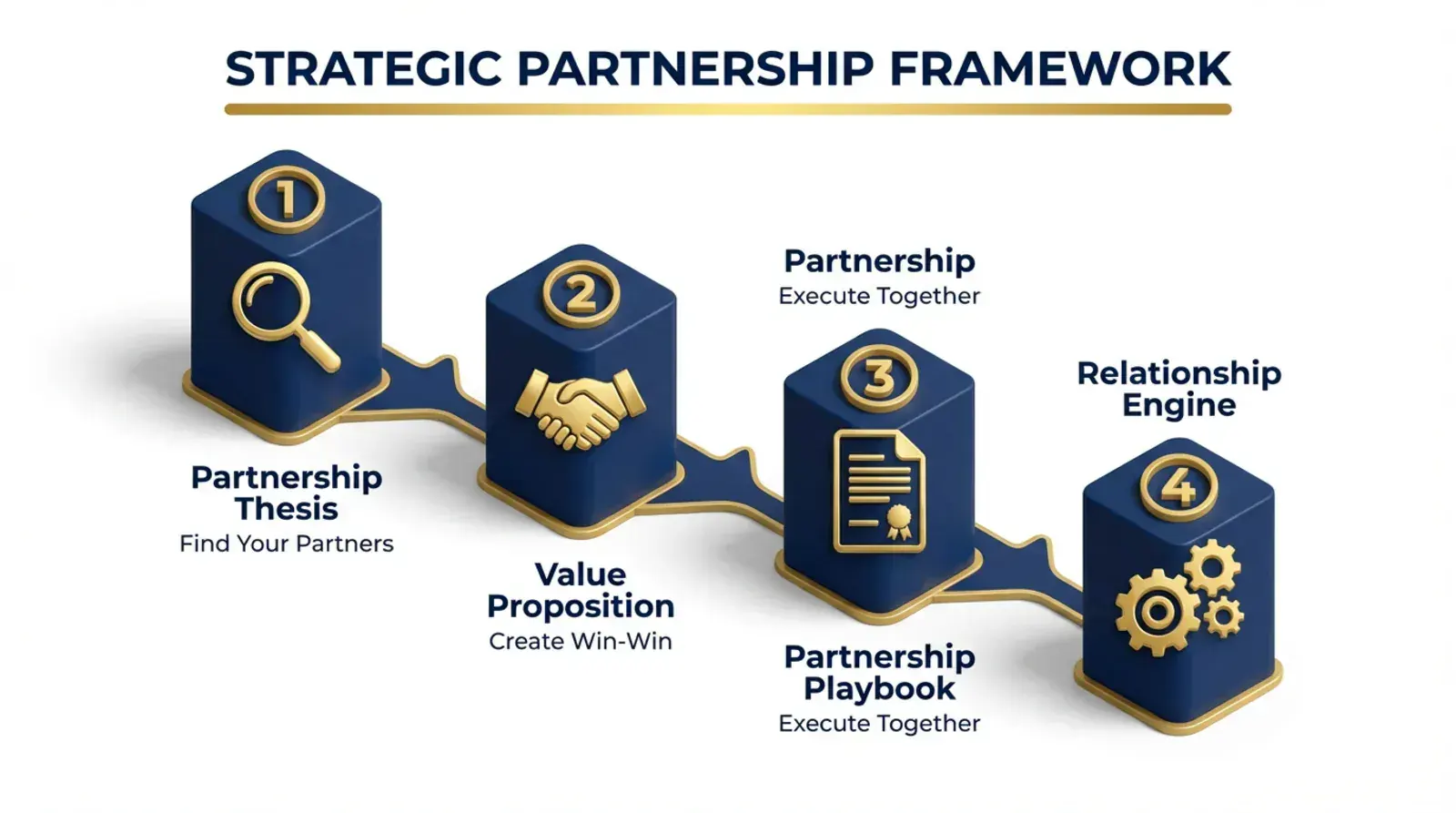
| Step | Strategic Question | The Goal |
|---|---|---|
| 1. The Partnership Thesis | Who has the trust and attention of our ideal customers? | To identify the universe of potential partners who could accelerate our growth. |
| 2. The Value Proposition | What is in it for them? | To craft a compelling and irresistible offer for our potential partners. |
| 3. The Partnership Playbook | How will we co-market, co-sell, and co-create value? | To create a clear and repeatable process for activating and managing our partnerships. |
| 4. The Relationship Engine | How will we nurture and grow our partnerships over time? | To move from one-off campaigns to long-term, strategic alliances. |
1. The Partnership Thesis: Who Has Your Customers Before You Do?
The first step in building a partnership strategy is to identify the universe of potential partners who already have a strong and trusted relationship with your ideal customers. Think broadly. This could include:
- Adjacent Technologies: Companies that sell a non-competitive product to the same customer base.
- Influencers and Media Companies: Individuals and organizations that have a large and engaged audience in your niche.
- Agencies and Consultants: Service providers who advise and implement solutions for your target customers.
- Industry Associations: The organizations that bring your ideal customers together.
2. The Value Proposition: The Art of the Win-Win
A partnership is a two-way street. To recruit a great partner, you must be able to articulate a clear and compelling answer to the question, "What's in it for me?" Your value proposition for your partners could include:
- Revenue Share: A percentage of the revenue you generate from the customers they refer.
- Co-Marketing Opportunities: Access to your audience through webinars, blog posts, and other content.
- Product Integrations: A tighter integration between your products that creates more value for your mutual customers.
- Referral Fees: A flat fee for every qualified lead they send your way.
The key is to create a value proposition that is so compelling that your ideal partners would be foolish to say no.
3. The Partnership Playbook: From Handshakes to High-Performing Channels
A partnership strategy without a clear execution plan is just a collection of good intentions. You must have a "partnership playbook" that outlines the specific and repeatable processes for how you will work with your partners. This should include playbooks for:
- Co-Marketing: How will you jointly create and promote content?
- Co-Selling: How will your sales teams work together to close deals?
- Onboarding and Training: How will you equip your partners to be successful?
- Tracking and Measurement: How will you measure the performance of your partnerships and attribute revenue?
4. The Relationship Engine: The Long-Term Game of Trust
The most valuable partnerships are not transactional; they are relational. They are built on a foundation of trust, communication, and a genuine commitment to mutual success. You must have a system for nurturing and growing your partnerships over time.
This includes regular check-ins, joint business planning, and a willingness to invest in your partners' success. A great partnership is a living, breathing thing that requires constant care and attention.
The Strategic Perspective: The Ecosystem is the New Organization
In the 21st century, the lines between companies are becoming increasingly blurred. The most successful companies are not the ones with the most internal resources, but the ones that are the best at orchestrating a vast and powerful ecosystem of external partners.
Your ability to build and manage this ecosystem is no longer a "nice-to-have"; it is a core competency for modern business.
The Infinite Game: From a Zero-Sum to a Positive-Sum Mentality
The traditional view of business is a zero-sum game. For me to win, you must lose. The partnership mindset is a positive-sum game. It is the belief that by working together, we can create a bigger pie for everyone.
It is the understanding that the greatest opportunities for growth lie not in competing with others, but in collaborating with them.
The founders who will build the enduring companies of the future are the ones who can make this mental shift. They are the ones who understand that the fastest way to scale is not by hiring, but by partnering. They are the ones who have mastered the art of scaling by multiplication.
Ready to build your partnership ecosystem?
Book Your Strategic Session